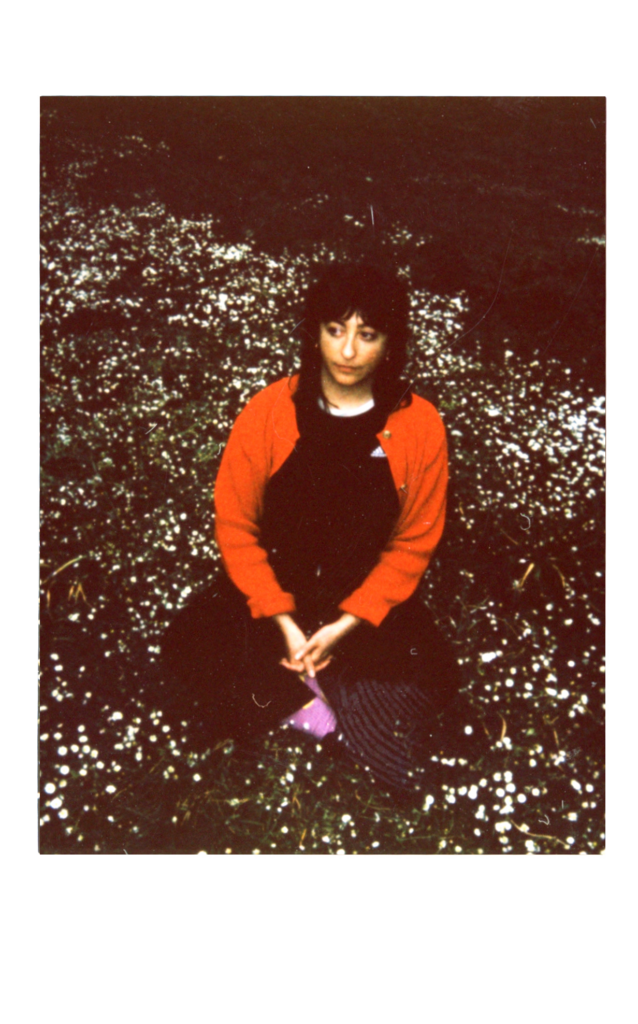
An interview with Abeera Kamran and Zeerak Ahmed, by Sophia Smith Galer
Ten years ago, Khawar Latif Khan and his sister had a problem. At almost the exact same time I would have been writing my own university essays in Arabic on Microsoft Word without a problem, the same software gave Khawar’s sister no such option for her own mother tongue, Urdu. Writing a 200-page dissertation in any language or script is hard enough. But Khawar and her sister had to re-type out all 200 pages into InPage, the Pakistani software that was the only way to type out Urdu in its script, known
as Nastaliq.
Then, they converted the text into Unicode. After that, they installed Urdu font packages for Microsoft Word. Only then were they able to bring the dissertation into Microsoft Word, reformat it, and present it in a way that could be handed in. Years later, he wrote that “the entire process could have been much simpler if Urdu had even half the amount of technical support as English or other Latin languages.”
People might call Latin a dead language, but they forget that part of it remains very much alive: its script. There are over 7,000 living languages today, and up to half of them use an alphabet crafted by the ancient Romans. The Latin alphabet, by far, is the most active orthography in the world.
Online, it can almost feel like Latin script was designed for the internet, given the ease with which you can type in a web address, or write a line of code, as if the Ancient Romans predicted the computer. Of course, in reality, it’s the other way around: it has everything to do with the internet being designed for Latin script.
In the 1960s, when engineers built the first computers we would (vaguely) recognise as such today, they onboarded the QWERTY keyboard that had been used on commercial typewriters for almost a century. The typewriter had already long made the QWERTY keyboard the industry standard for English-language keyboards; now, with the United States taking the lead in the computer revolution, this would become the internet’s standard too, with its 26 letters, its numbers, and its punctuation.
From a design standpoint, the Latin alphabet as modelled by English offered simplicity. The letters are all separated, it’s blocky, and it’s written in a straight line. But it also had the advantage of being the writing system of all the Western macrolanguages that had been expanded during the age of empire. As a result, the first computers suited a good 70 per cent of the global population (albeit with minor variations – e.g. a French computer keyboard’s top line reads AZERTY). The rest of the world looked on, with their myriad scripts, waiting to be digitised. And, incredibly, for Urdu – a language with 230 million speakers today – that wait is ongoing.
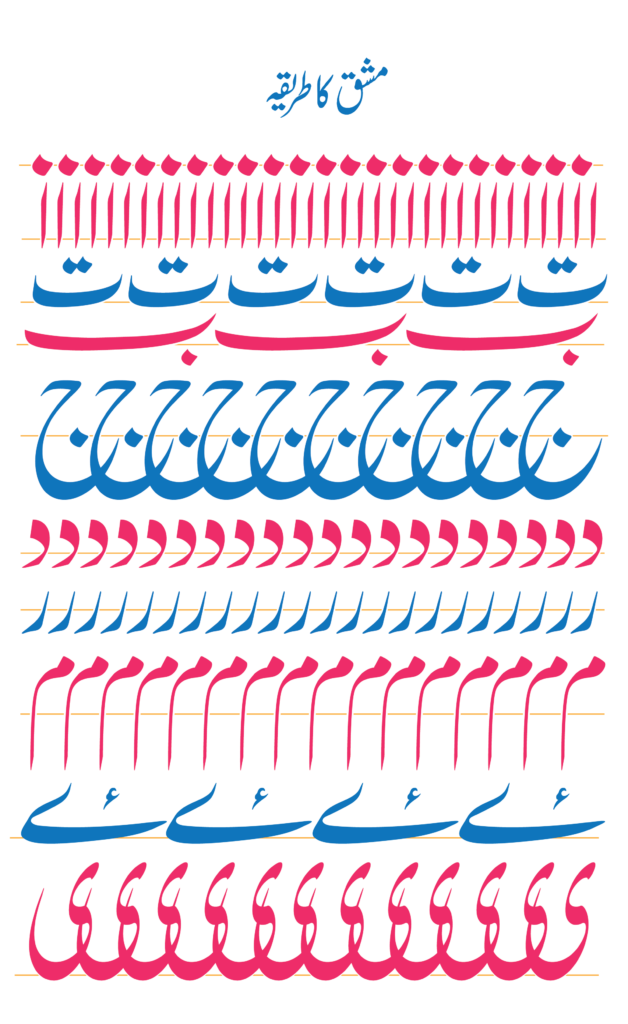
A Nastaʿlīq exercise sheet used to practice letterforms is both instruction and art. It is a way for master calligrapher to teach their apprentice the perfection of Nastaʿlīq letterforms, an exercise of discipline and focus. It is also considered its own art form, known for dense arrangements of letters, often illegible and abstracted, and a frenetic rhythm created by the repetition of forms.
Nastaliq – nicknamed the bride of Islamic calligraphy – is one of the most complex calligraphic styles on the planet. If you are a Persian speaker, you may recognise it from poetry you have read, where it is an intentional literary style; but if you’re an Urdu speaker, you will recognise Nastaliq as the way you write everything. Developed in Iran from the 13th and 14th century, this became the script of Safavid royal scriptoriums and would define literary sophistication across the Indian subcontinent for centuries. Urdu speakers proudly connect their own language’s lyricism to this writing style, to the point that newspapers were handwritten until the 1980s.
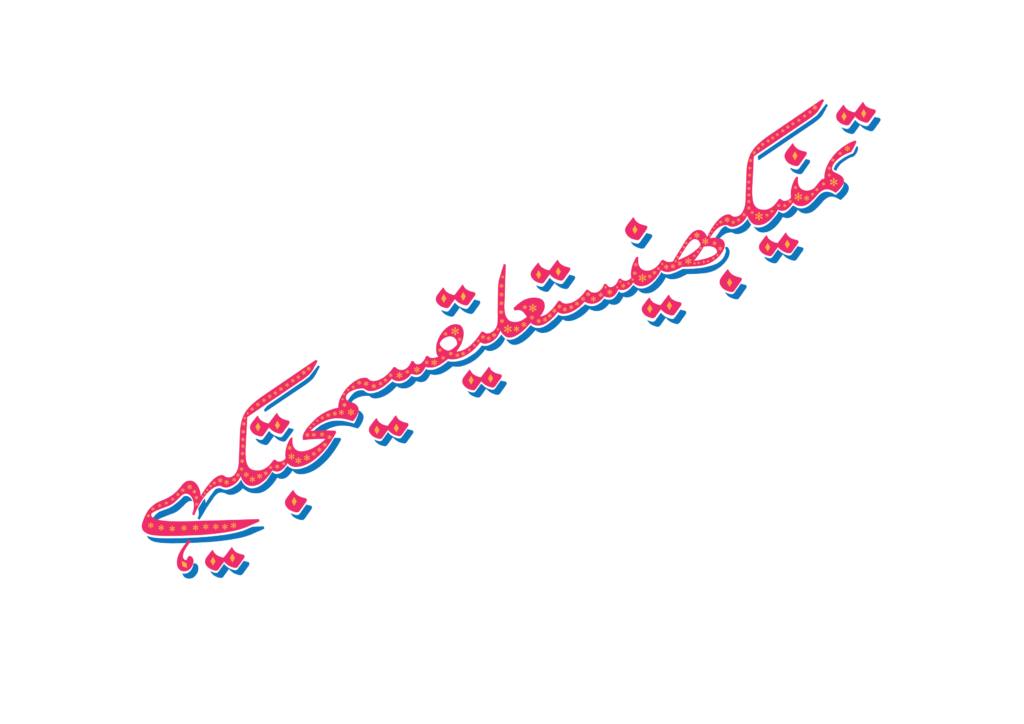
Cascading and diagonal, it is everything the Latin alphabet is not: it’s not on a straight line, all its characters are joined together, and rounded dots called nukta pepper the text. On the first computers, you simply couldn’t render it; by the 1980s, even the first software that got developed created text that wasn’t searchable, and wouldn’t work the minute you put a document on the web. Today, Nastaliq text remains unreadable at a small size, has its ligatures stretched beyond comprehension across websites, and has barely any high-quality digital fonts or browser support.
“The whole system is broken,” says Zeerak Ahmed, a designer and engineer born in Lahore who has become a collector of mind-boggling stories about the tricks and stopgaps Urdu speakers contort themselves into to write their own language. He once heard about someone writing Urdu on their computer by Googling for letters, copying them all individually, and pasting them into their document. Another time, he asked a publishing house how they were correcting spelling mistakes, and discovered that they didn’t even have the software to open Urdu-language Word documents. Instead, they had been sending books to the only colleague they knew who was able to open them, who had to retype them out in full, and email them back.
“We care the most about fonts in the world. No one cares about fonts as much as Pakistanis do,” Ahmed jokes. Because Urdu speakers got so used to sending text that wouldn’t open properly on other people’s computers, they started sending images instead, a tradition that has lasted even until today in the WhatsApp poetry that is shared across groupchats. Even though the internet is not as bad today as it was in the 1980s, the Unicode Consortium – which helps encode all languages on the internet – only began to platform Urdu in the early 2000s. “The practice of sending each other images established itself,” Ahmed says.
It was also embedded in newspapers. Across the border in India, the Urdu-language Chennai newspaper The Musulman is said to be the only surviving handwritten newspaper in the world. Scribes still write out the whole newspaper in Nastaliq before it is mass produced by a printing press. Although most Urdu-language newspapers are printed today, many of them are still not searchable online; editorial teams will upload an image of the newspaper and hyperlink the headlines to individual web articles as the sole means of making the content accessible. Just one newspaper, which also happens to be the biggest – Jang – is the only newspaper that has live HTML text, but it’s written entirely in Naskh, the same linear cursive script that I would have been typing my Arabic essays in. It is not the traditional script of Urdu; it is used simply because it’s the closest script that can make Urdu legible on the internet.
Although it serves way more operating systems, Naskh is self-limiting for Urdu, whose Nastaliq clusters words into meaningful visual units and distinctive shapes that give it its specific Urdu personality. When I write in Arabic, a letter can appear one of up to four ways, depending on where in the word it sits or whether it stands alone. In Nastaliq, there can be anything from 10 to nearly 80 different contexts a letter can sit in. Even spaces defy digitisation, as Ahmed explains to me. “In English, we use space characters to indicate when a word ends and begins, which is just as visible to a human as it is to a computer. Urdu typesetters use spaces to move words next to or further away from each other in a way that’s aesthetically pleasing. They don’t use it as a way of telling you when a word starts and ends.”
The lack of resources for digitising Urdu is bad news for the Urdu-speaking information ecosystem, today and tomorrow. Now that the internet is being scraped for large language models, AI models lack Urdu language training data to learn from; if it can’t read spaces and where words start and end, it can’t formulate the prediction models that train its systems, or it simply does so on data that is full of corruptions. This will mean that the knowledge and information encoded in the Urdu language will be absent from AI innovation – although that might be gratifying news for anyone worried that the more languages AI can read, the more slop it will produce in those languages. Ahmed is hopeful that part of this could actually be solved because “the image reading problem in Urdu is much easier than in English – most Urdu text is published in one of three or four fonts. So, your ability to train a system to read text should be much easier. But we just haven’t done that, because we’re behind for all sorts of historic and economic reasons. We can get around to solving it – we just don’t have the resources to do it.”
For Abeera Kamran, a typographer and graphic designer who works between Birmingham and Karachi, the existing lack of Urdu digitisation means it’s simply harder for her to do her work: “If Urdu research gets produced, it gets siloed.” In a world where so much progress in research comes through serendipitous connections and networks – “networking through hyperlinks”, as Kamran terms it – this is a major issue.
Many Urdu writers in research end up deferring to Romanised Urdu, using the Latin script, in a way which is totally unstandardised – making Kamran’s life even harder: “Sometimes I’ll have to trial five different spellings to figure out what might be the spelling of the source I’m looking for. It is a very chaotic, slow process. Mostly, I think it means you don’t foster relationships with researchers that could happen, because you’re unlikely to discover each other.”
WhatsApp poetry JPEGs, Naskh news articles and romanised resources mean that Urdu is technically all over the internet – but it’s an unhappy fate for Nastaliq, as deeply culturally associated with writing Urdu as the Latin alphabet is for writing English. Nastaliq doesn’t just write Urdu, it identifies it, marking it out from its neighbours.
As a language, Urdu emerged some time around the 12th century CE, amidst the Arabic which Islam had brought to South Asia, the Persian of invading sultans, and the Sanskrit that had always been in the Indian subcontinent. This was not Urdu as we quite know it today, demarcated from Hindi; back then, both languages were seen as one Hindustani lingua franca. By the 18th century, this had become the language of the upper classes of northern India, who were losing their Persian language with the decline of the Mughals, but not their Persian script. Writing during this period started to be called زبان اردو – Zaban-e Urdu, language of the camp – referring to the language spoken in Mughal military camps. It was promoted by the British East India Company, who wanted it standardised as a language for the courts and local administration alongside English.
It was only when Hindu intellectuals began making the case for Hindustani to be represented in Devanagari script, with more Sanskrit-based vocabulary, that the two languages began to diverge. Spoken, they had basically been the same; written down, they were now two distinct languages, representing two completely different religiously defined populations.
“If you know anything about Indians or Pakistanis, you know so much of the food is shared, so much of the language is shared, so much of the dress is shared,” Kamran says. “The script became one of the ways of distinguishing those two communities – specifically Muslims in pre-independence India who were advocating for a separate Muslim nation state. The script became a lightning point for saying what was Muslim identity, what was Muslim Pakistani identity.”
Anyone who has seen Islamic calligraphy will know that there are a plethora of ways to write in it. While Nastaliq has been one of many styles used to write Persian-influenced languages across the Indian subcontinent, a calligrapher, Abdul Majeed Parveen Raqam, took the Nastaliq that had been mastered in Iran in the 14th century and essentially verticalised it as a means of modernising the script, “to echo the mindset of a forward-thinking Muslim and eventually Pakistani nation state,” Kamran says.
As Muslim identity in India began to coalesce around Urdu, it also coalesced around a new Nastaliq that was named Lahori Nastaliq. Muhammad Iqbal, a 20th-century poet considered a national treasure in Pakistan, famously said that he would refuse to publish his poetry unless it was published in Lahori Nastaliq. I wonder what Iqbal would make of contemporary software, its lethargy to accommodate Nastaliq, and his poetry being shared in JPEGs.
Kamran and Ahmed are approaching the technological challenges associated with Nastaliq in two different, but complementary, ways. An AHRC-funded PhD student at the University of Reading, Kamran is helping to develop an open-source typographic framework for global scripts, using Lahori Nastaliq as a case study that could improve the digital fates of many other writing systems, too.
In its refusal to alter itself for the digital age, Kamran believes that Urdu’s remarkable print tradition should be used to speed up digital typography innovation. “I think there is something remarkable about it,” she says, with pride. “Sometimes a single headline can take up to an hour to design. And editors often have aesthetic feedback as well, where they’ll say, ‘No, you should have layered it differently.” She listed all the mechanics’ and plumbers’ shops that have signs in elegant Nastaliq that must have been painted with extreme care. All of these typographical references, often using similar structures, should be used to build an open-source framework for readable Urdu, including giving Urdu usable font sizes, and clear hierarchies for headings and subheadings. All the sorts of user interface and layouts that you – if you can read this article – have likely always taken for granted, myself included.
Zeerak Ahmed, who by day works as a Senior Manager of Research & Innovation at Amazon, has by night and weekend created Matnsaz, an iOS app you can download which allows the user to type with an adapted Arabic keyboard, autocorrecting to Urdu word shapes and adding diacritics seamlessly based on the inputs of language scholars. In order to build it, Ahmed and his team built Makhzan, now the highest-quality Urdu language repository online, because pre-existing language resources weren’t good enough.
By grouping letters by shape, Matnsaz has managed to reduce the 39-letter Urdu keyboard to just 21 keys, making it quicker to type Urdu on your phone. Not only is it novel, but in theory it can be expanded to support any language that uses adapted Arabic script; yes, there is a Nastaliq option, but there is also Naskh and – in theory – the ability for Matnsaz to support languages like Farsi and Sindhi. “Right now, if you go from Urdu to Sindhi, you actually have to switch layouts,” Ahmed explains. “It becomes problematic because Urdu speakers are mostly bilingual or multilingual. So, building an Urdu keyboard without that kind of understanding of the rest of the world would be incomplete. We’ve spent so much time with Urdu that we haven’t extended it so far – but the goal is to do that.”
Urdu is not alone in its attempts to claw back inclusion in an internet made for English. In the most recent proposals made to the Unicode Consortium, which were discussed in April 2025, there were requests to add the sign for the Saudi Riyal and N’ko phonetic extensions for Malian languages, as well as for changes to the positioning of combining marks in the East Asian language of Tai Yo. Within the group’s discussions, requests are still denied on the basis that languages encoded to behave like Latin text can only rotate characters in the way that Latin works. About 20 living languages are referenced in this round alone, showing how many communities still yearn for easier ways to type, read, and realise their languages online. In a news cycle filled with tech bros telling us that anything is possible, Urdu and Nastaliq remind us that there is still a long way to go before we will ever have a genuinely multilingual web.
Contrary to appearance, this is not a word but a complete sentence in Urdu where the natural word spaces have been removed to create a single long word-sentence. It translates to “have you ever loved Nastaʿlīq’, a riff off a popular meme seen on Urdu social media. This way of removing spaces is a calligraphic trick that highlights the cascading nature of Nastaʿlīq, beautifying it further