Translator reviews the winner of the National Book Award for Translated Literature
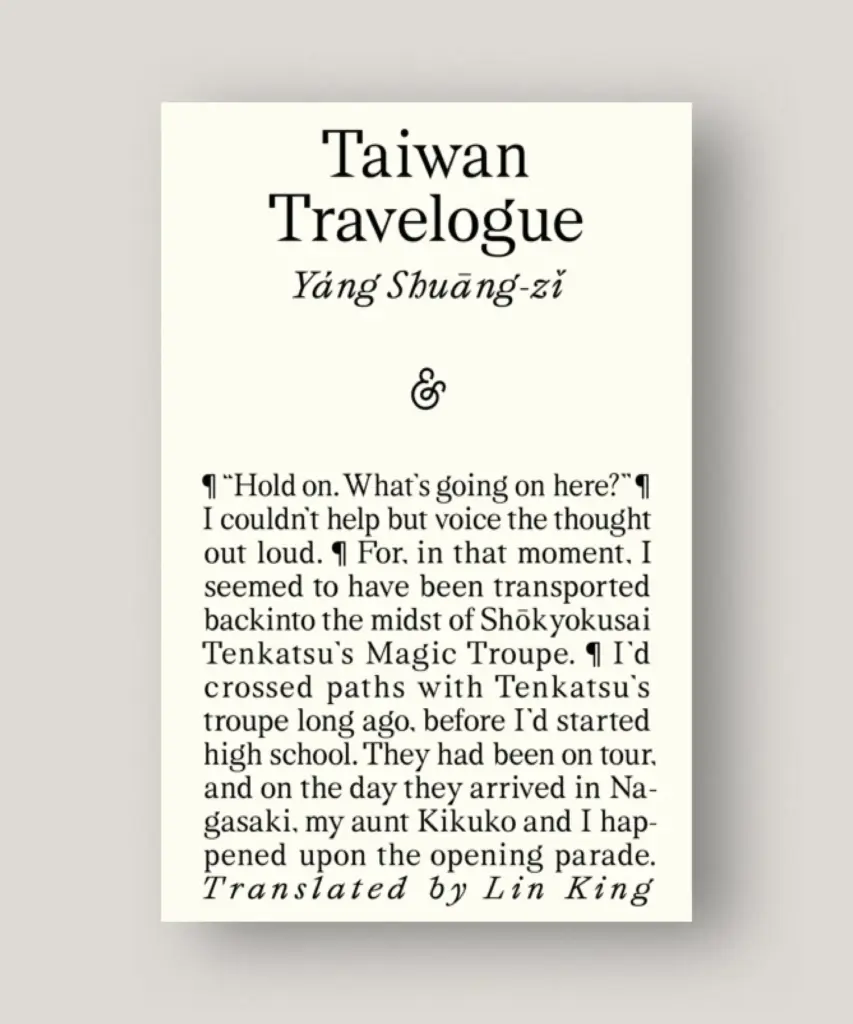
Taiwan Travelogue
by Yáng Shuāng-zĭ,
Graywolf Press, 2024, 320 pages
Taiwan Travelogue (臺灣漫遊錄), by Taiwanese author Yáng Shuāng-zǐ is a postcolonial and feminist reimagining of Taiwan’s colonial past. Framed as a fictional travel journal “translated” from a 1954 Japanese text by a fabricated author, the novel cleverly blurs the lines between original and translation, fact and fiction. Set in 1938 during the final years of Japanese colonial rule in Taiwan, the story follows two women: Aoyama Chizuko, a Japanese writer from Nagasaki, and Wáng Chiēn-hō (Ông Tshian-ho̍h in Taiwanese, or Ō Chizuru in Japanese), her Taiwanese interpreter. Their relationship, which unfolds gradually over the course of the novel, becomes a prism through which the politics of intimacy, empire, and identity are refracted.
Food anchors the novel’s arc: twelve beloved Taiwanese dishes mark each chapter, serving as emotional cues as much as narrative signposts. The story opens with Kue-Tsí (roasted seeds), where the crisp shell-cracking sound captures the energy of new encounters and the freshness of unfamiliar landscapes. Throughout the journey, the two protagonists travel Taiwan’s Japanese-built railways, stopping in towns and countryside alike. Their meals become more than moments of rest; they are sites of memory and meaning, where intimacy meets asymmetry, and where the legacy of colonialism seeps into the textures of everyday life. It ends with Kam-Á-Bit (fruit and jelly ice), whose melting sweetness becomes a gentle metaphor for reconciliation: two worlds, once held apart, slowly begin to blend. In that moment of shared dessert together, grief is not erased but softened, transformed into something tender.
Taiwan Travelogue, built on anachronisms, fictional footnotes, and layered voices, unsettles the conventions of historical fiction to reveal the contradictions of empire—its blend of modernity and repression, affection and control. Aoyama’s admiring yet condescending gaze contrasts with Wáng’s quiet strength. Through silence, subtle gestures, and cultural fluency, Wáng claims a dignity shaped by constraint but not defined by it. These narrative strategies allow the novel to move fluidly across registers: as a meditation on female intimacy in the yuri tradition, a nuanced reflection on colonial ambivalence, and a work of archival imagi-
nation that reclaims forgotten voices. Together, they make the novel politically and emotionally resonant.
However, despite its sharp critical standpoint, what lingers most for me are the moments of stillness. I find healing in the serenity Yáng evokes: in unspoken gestures, in landscapes glimpsed through train windows, in the time-space shared by two women. Her refusal of historical spectacle, and her focus instead on how these two women feel their way through a world shaped by desire and tension, offering not resolution, but rest. In that rest, I found space to breathe and that quiet stayed with me.
This novel arrives with no shortage of compelling angles—from nostalgic food culture and historical railway journeys to a subtle reimagining of the yuri genre (in Japanese yuri means lily; the genre foregrounds romantic same-sex relationships, and is currently undergoing something of a resurgence). Each of these threads has already been thoroughly explored in reviews, podcasts, and literary discussions. However, since this is the inaugural issue of a translation-themed magazine, I want to turn the spotlight toward the novel’s most obvious yet radical gesture: its bold, layered treatment of translation.
For me, translation is the act of transcending walls and making room for encounters that might otherwise never happen. It is a hope that across language, history, and difference, we might come to understand one another. What makes Taiwan Travelogue especially compelling is how it engages in a paradoxical kind of translation—imaginary translation—one that begins by building a wall, only to gently pass through it.
The novel’s fictional Japanese original, invented translator, and its narrative layers may seem like barriers at first, but through these distancing devices, a mental space unfolds: where empathy can be practiced not as projection or sentiment, but as a kind of deliberate estrangement. To imagine being translated is to imagine being misread, footnoted, edited—to feel oneself scattered and reassembled by another’s hand. In this way, Taiwan Travelogue enacts the literary ethics of care, inviting us not to collapse difference, but to feel through it and to listen across language, power, and silence. Translation—both real and imagined—becomes a method for asking harder questions: How do we carry history? How do we live within another’s grammar?
Nevertheless, if imaginary translation opens up that ethical space on the level of form, it was the act of actual translation—the English version rendered by Lin King—that most reshaped my own perspective. As a Cantonese speaker fluent in written English, I came to understand how translation doesn’t just transfer meaning, it also actively generates new ways of seeing.
Because Cantonese, Mandarin, Hokkien, and even Japanese Kanji could share the same written form, the boundaries between voices blurred on the page.
When I first read the original Chinese version years ago, whether it was Aoyama speaking or Wáng replying, I heard them both in Cantonese—effortlessly, unconsciously. Where the Chinese version allowed for the quiet co-existence of multiple languages and positionalities through the shared iconography of Han characters, the English translation had to choose, to take a stance. And Lin King, the translator of Taiwan Travelogue, chose complexity over clarity, discomfort over assimilation.
That choice reshapes the entire reading experience by introducing a subtle friction and a feeling of uneasiness. Through her decisions and footnotes, she reconstructs an entire colonial soundscape that forces readers to confront the layered, contested nature of Taiwanese identity. Her decision to use Japanese colonial pronunciations—rendering 台中 as Taichū instead of Táichūng, 媽祖 as Maso instead of Mātsǔ, and the way Aoyama called 王千鶴O Chizuru rather than Wáng Chiēn-hō or Ông Tshian-ho̍h—creates an effect that is not just linguistic, but deeply affective.
By retaining these Japanese pronunciations, the English version doesn’t just translate Taiwan’s colonial past but performs it. It makes the linguistic confusion part of the narrative experience, forcing readers to navigate shifting frames of reference, just as the characters must.
In this way, translation becomes authorship, a process of reinventing meaning. Lin King is not simply carrying Yáng’s words across linguistic borders; she is re-inscribing the politics of language into the very architecture of the novel. The tension she negotiates—between sound and meaning, between identity and representation—becomes the reader’s tension. And that dissonance, full of echoes and erasures, is precisely what colonial modernity feels like. Such embracement of friction rather than fluency reminds us that the seams are part of the story.
In the end, what stays with me is not just what Taiwan Travelogue says about history or identity, but how it quietly changed the way I read. As a Cantonese speaker encountering the English translation, I felt the friction, the unfamiliarity—and also the care. Through both its imagined and actual translations, the novel taught me that meaning doesn’t always emerge from harmony, but from the willingness to dwell in dissonance. Translation, here, becomes an ethical gesture: a way of attending to voices that might otherwise remain unheard. A reminder that to translate—and to be translated—is to risk being misunderstood, and to choose connection anyway. And in that act of layered listening, something tender remains—like the soft dissolve of Kam-Á-Bit, sweet and fleeting, yet enough to stay with you.