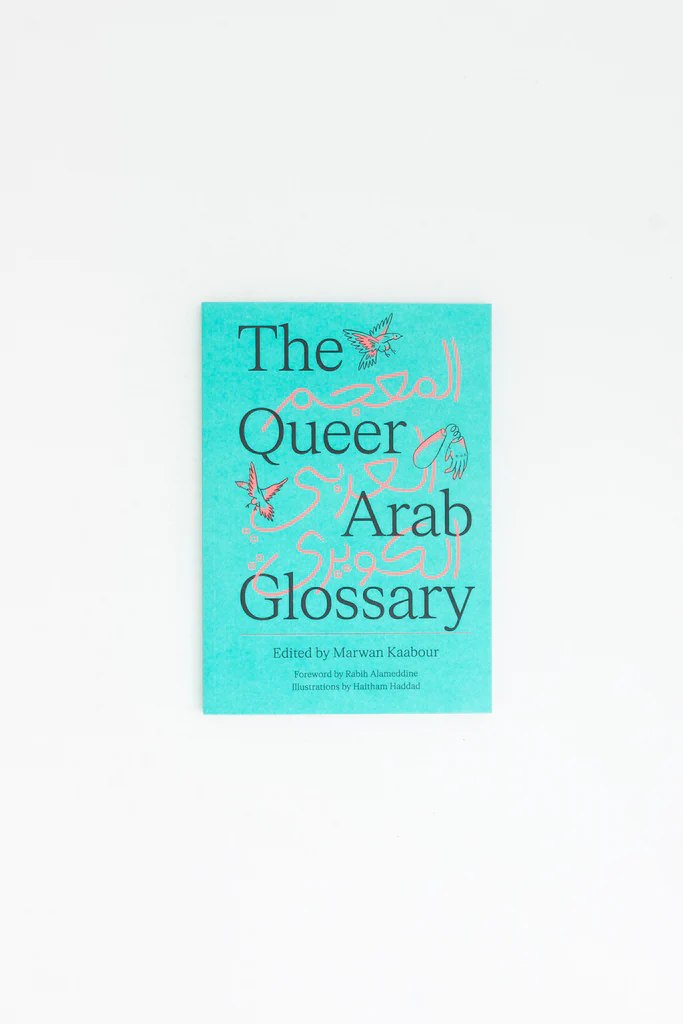
The Queer Arab Glossary
ed. Marwan Kaabour,
Saqi Books, 2024
160 pages
The Queer Arab Glossary is, first and foremost, an act of presence. In a world that often paints Arab societies with a broad brush of conservatism, this book insists that queerness has always existed, painfully and joyfully, in Arabic-speaking worlds. Edited by Marwan Kaabour, the book is a prolific, multi-dialect archive of slang, slurs, euphemisms, and reclaimed language from across the Arab region.
The glossary includes words that describe sexual acts like Ballā’a which means mouth of a drain i.e someone who swallows, referring to men performing fellatio on other men or ‘Attāy, which means giver, the person who generously gives his body to someone i.e a bottom. Suhāqiyya, meaning ‘grinder’, is a classical term for lesbian. Lahhāsa, or licker, means a queer woman. Some words are Arabisations and feminisations from English: Botmah (from Bottom), Shīmayl/Shīmayla (from ‘she-male’) or Bofta (from the British slur ‘poofter’). Others, like Pédé (a derogatory word for gay) and Tante/Tantina/Tanta (aunt, which can mean queen, pansy or elderly gay man) are French words commonly used in Arabic countries colonised by France.
Even though there are terms that carry violence and shame, an irreverent joy pulses through the glossary. Part of that joy comes from the language itself but also from Haitham Haddad’s quirky and twisted illustrations that give the book a levity which lifts the macabre histories the words carry. The glossary doesn’t just catalogue, it also connects. Across dialects and borders, a thread of queer expression emerges. Language is not only regional but relational, shaped by migration, intimacy, and resistance.
Ultimately, The Queer Arab Glossary is not just a reference book. It is an archive of memory, a site of resistance, and a map for queer self-understanding.