Living and dying with lions (and tigers) on the Nile
On April 2, Egyptian father Ibrahim Abdel Fattah, dressed in his worn-out jilbab, stood next to a representative of the investigating authorities from the First Tanta Police Department in the Gharbia Governorate. He extended his left hand, perhaps a sign of weakness, to collect a burial certificate for an amputated part of his son Mohamed Ibrahim’s arm. The rest of the young man’s arm was devoured by Bocca the tiger at the circus in Tanta, in an incident that has recently gone viral across social media and news platforms.
Jilbab
A long, loose-fitting cotton garment worn in varying styles by men and women

Tanta
The capital city of the Gharbia Governorate, about 90 kilometres north of Cairo

Sign of weakness
In Arab and Islamic cultures, the right hand is customarily used for eating, receiving items, greetings, and such. That Ibrahim Abdel Fattah used his left hand is a sign of resignation and powerlessness in this situation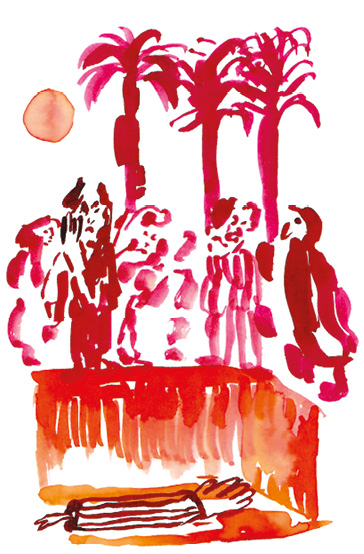
The father then took the severed limb and made his way back to his village to bury it. The ceremony was thinly attended: just two young men walking behind him to the graveside. Then, it was done. The burial of an arm!
Meanwhile, the patient Mohamed Ibrahim was in a government hospital in Tanta, waiting for someone to come and pat the remaining part of his arm, or offer him compensation. He hoped at least for some kind words from the Kouta family, who run the dangerous show he was working on when the incident occurred.
Public statements
Video statements of Kouta talking to the press attracted over twenty thousand views and some impassioned comments from viewers coming to Ibrahim and/or Medhat’s defence. Medhat unabashedly defended his family and their profession, and reminded the public that while they may know their cats and dogs, they don’t know lions and tigers like the Koutas do. His comments were full of impassioned, deflecting, rhetorical questions, chief among them: why did Ibrahim put his whole arm in the cage in the first place?
But the Koutas were otherwise engaged. The owner of the circus, Anousa Kouta, was busy searching for a way to absolve herself of any responsibility for what happened. Meanwhile Medhat Kouta, her father, was spending his time making flagrantly scornful public statements mocking the victim and even accusing him of being the author of his own misfortune.
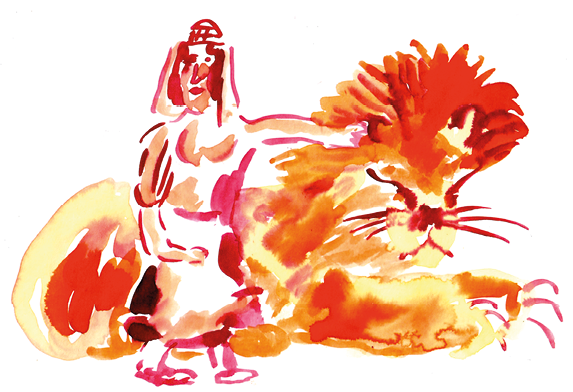
What a happy animal; what an unlucky human!
Did you find Medhat Kouta’s remarks a little sickening? Did you feel the insults? If Mehdat Kouta’s declarations cut a little close to the bone, it may rub salt in the wound to recall that the world itself is but a big circus: the fiercest animals are tamed by the strongest of humans, and both feed on the flesh of the weak. And this is not the first time a worker’s flesh has become meat for others at the Kouta family circus—last time was just as serious!
Let’s rewind twenty-five years or so to the summer of 1996. There was a young Egyptian man named Ahmed Mohamed Sulaiman who lived in Alexandria with his siblings and his late father’s wife. Ahmad had never attended school, and his only previous job had been as a porter.
Something new entered Ahmed’s life that year when he visited Elhelw Circus, owned by Mahasen Elhelw, the mother of Medhat Kouta. The show took place during the annual celebrations around the anniversary of the birth of Ibrahim al-Desouki in Kafr El Sheikh. Ahmed was entranced. Eager to keep watching the magic he got himself a temporary job working at the circus buffet. Two weeks later, the festivities concluded, the lights were switched off and down came the tent.
Ibrahim al-Desouki
A famed 13th century Egyptian Imam
As far as the circus was concerned, Ahmed was now surplus to requirements. Looking for a way to scrape together a living, he asked them if they had any other work he could take on. Suddenly, he found himself looking after the lions: cleaning their cages, feeding them, watching over them and, at the end of the workday, sleeping next to their cage. That is, until the day that Ahmed, feeling himself secure in their presence, turned his back to the beasts. One of the lions attacked, tearing the young man to pieces until he met his end.
Almussawar
A weekly magazine, established in 1925, that covers current affairs.
On November 14, 1997, Almussawar magazine published an investigation into the incident. In its reporting Medhat Kouta made statements no less callous than his more recent commentaries. As he put it: “The circus pays 4000 Egyptian pounds a month to feed the animals” and “human meat is sweet. If a lion gets a taste of a human’s flesh, that person won’t be working again.”
Sweet
Interestingly, the root of the Arabic word مسكر used here can mean both “sweet” and “intoxicating”

Giza Governorate
On the opposite bank of the Nile from the Cairo Governorate
What Kouta says is technically correct. But his words incriminate him, rather than absolve him. The ravenous animals in his circus are fed on donkey meat, the cheapest of the lot. And donkey meat has similar characteristics to human flesh. In the words of Dr. Shireen Ali Zaki, a vet in the Giza Governorate and head of the food safety committee in the Egyptian Veterinarians Syndicate, donkey meat “tastes sweet because it contains a high amount of glycogen, which is a starchy carbohydrate.”
In short, the circus’s lions and tigers have become accustomed to “sweet” meat. It makes no difference whether it’s flesh from a donkey or from a human.
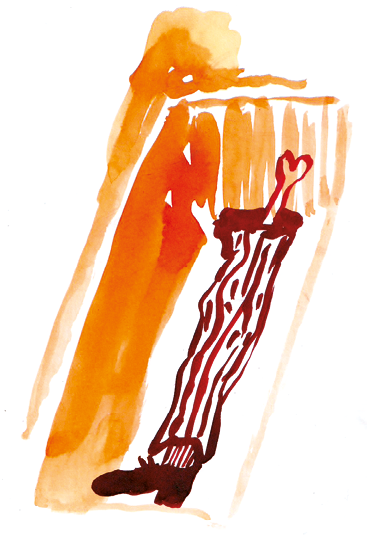
Take two: where is Uncle Suleiman’s leg?!
Back in 2002, a simple worker called Suleiman Ashour Suleiman was on the payroll of the National Circus in Agouza, Cairo, where he had been a lion keeper for over twenty years. On the night of January 4 of that year, another dazzling performance came to an end and Suleiman and his colleagues led the predatory animals to their cages. For one reason or another, Suleiman had to go back to one of the cages later—the one that contained Mohsen the tiger.
There are different accounts of what happened next. Some say that one of Suleiman’s legs slipped between the iron bars of the cage, coming within reach of Mohsen, who promptly grabbed the leg and devoured it. Another version says that Mohsen reached his claws out between the bars and grabbed Suleiman’s shoe, not letting go until he’d dragged the keeper’s leg into the cage and ravaged it.
Suleiman was taken to a hospital in Agouza, to a bed with his amputated leg by his side—a scene captured by Almussawar, which devoted a whole feature to Suleiman, asking him what had happened. His responses were wholly accepting of his fate and of divine decree. He described his routine: that he receives forty to fifty donkeys from a supplier each week, and is in charge of cleaning and slaughtering them before feeding six donkeys to the lions and tigers every day. Each one gets twenty-five kilos.
The accident provoked the late writer and thinker Dr. Galal Amin to write an unprecedented article in Al Araby newspaper unpacking the events from social and economic standpoints, and what it says about the world we live in. Since then, the only thing that has changed are the names: Mohsen became Bocca; Suleiman has become Mohamed.
As Amin wrote: “The National Circus is made up of two worlds. At its zenith, of course, is the Elhelw family, the founders of the circus which they are said to rent from the government through a private-sector company appearing under different names: sometimes it is the Egyptian European Circus Company, sometimes it is the Fun and Games Company. Many suggest that the actual owner is always the same: circus manager Ibrahim Elhelw. At its nadir is the simple worker Suleiman Ashour Suleiman.”
Concluding his unyielding analysis, Amin argued that “Suleiman and others cannot afford to hope beyond each day. Life has taught them the dangers of thinking about tomorrow, when they have no health insurance, nor even the certainty that they’ll still have their job. Wisdom dictates that they limit their thinking to today and not thereafter, for if anything unexpected happens today, like a tiger ravaging their leg, the only hope is that Allah sends a benefactor to find a way for them to continue in their role, even if it is with one leg.”
Everyone is looking for a benefactor
Within days of Suleiman’s accident, Amin wrote, Egyptians had showered him with kindness and sympathy. Many visited Suleiman in hospital—young and old, celebrities—each one bestowing on him an anonymous envelope of money.
Amin’s account aligns with the observations of Akhbar el-Yom newspaper in an article published six months after the accident (August 2, 2002): “during our first visit to Suleiman in hospital, just one day after the accident, he requested a flat to reside in, now that he is unable to return to work at the circus. The circus was his home; he had nowhere else to go.”
The newspaper added that their Disaster Response Fund had “found a room in the Imbaba area, and the Fund paid 1,500EGP rent in advance so that it could become Suleiman’s new home. We also set up the place to suit Suleiman’s needs, buying simple furnishings that cost no more than 1,400EGP. We had 5,000EGP ring-fenced for supporting Suleiman through the disaster he had faced. Of this amount 2,100EGP was left, which we gave to Suleiman to keep on hand for life’s necessities.”
100,000EGP
This is a potentially life-changing amount of money, whether used to cover rent for an extended period, take time away from work, or provide financial stability
Such a benefactor also made an appearance in Ibrahim’s story when media personality and businessman Amr Adib announced that he would be giving the afflicted Ibrahim 100,000EGP. This coincided with the Minister of Labour, Mohamed Gibran, providing Ibrahim with a job opportunity at a pharmaceutical company.
Young Ahmed Mohamed Sulaiman passed away in the late 1990s, Suleiman Ashour Suleiman’s leg was amputated at the start of the new millennium and Mohamed Ibrahim’s arm was devoured just a few days ago. Each accident leads back to one thing, pointed out by Galal Amin: “half the population has become a nation of hungry people unto itself.”