A searing, child’s-eye view of apartheid-era South Africa
This piece was originally written in Kaaps, the foundational language from which Afrikaans was developed and later standardised under white minority rule. Developed under conditions of enslavement, it is widely spoken by people from the Cape Flats, a generally poor area of Cape Town with a complicated political and social history. Over time, Kaaps evolved independently from the standard Afrikaans spoken in the rest of South Africa, with its own rules and specific words. In the Apartheid era of white rule, Kaaps was perceived as an inferior, impure dialect.
Nineteen sixty-six
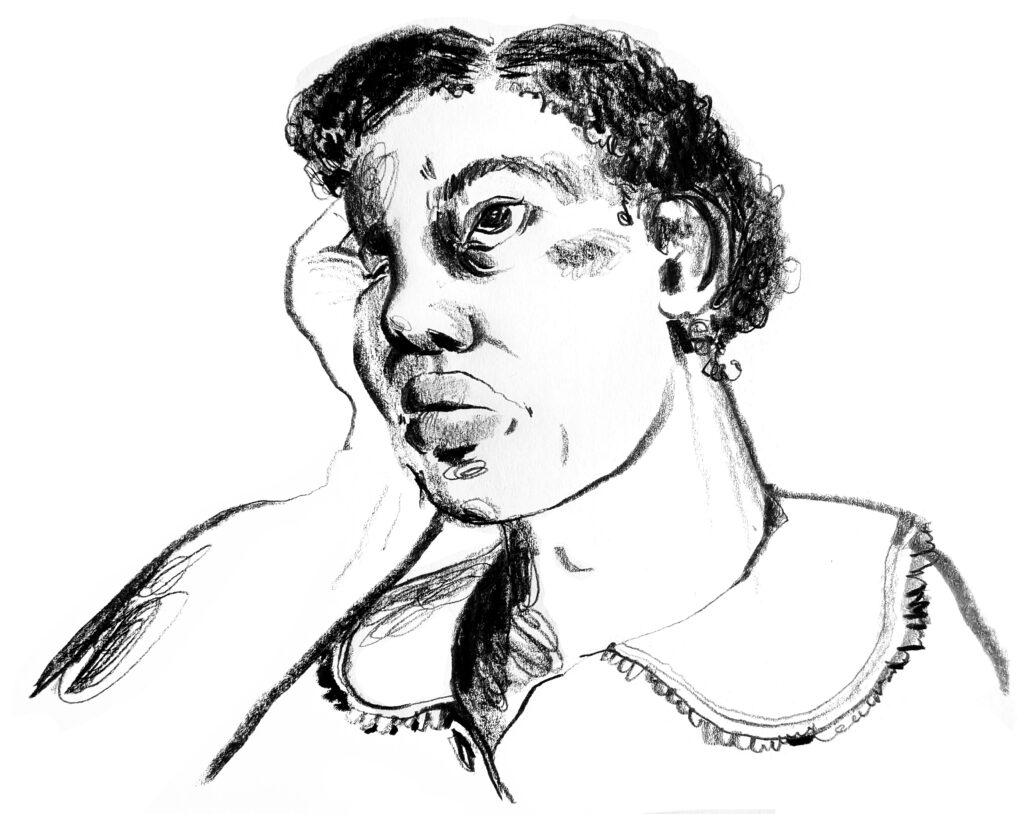
The thought runs through my mind: “To hell with school, to hell with everyone.” The long, shiny curls on my head are smeared with chicken fat. Everyone is fixing me up for the day, even the nosy neighbour, Missus Lancaster, whose hands feel rough across my face as she massages it like she’s being paid.
The house is a mess this morning. It’s my first day at school, and my mother and father left for work at the crack of dawn. Biya feels it’s her duty that she takes me to school. I leave the house barefoot, wearing a bottle green pillowcase dress – a pillowcase with two holes for the arms and one for the head – and carrying a school suitcase that just yesterday still served as a storage place for underwear.
Carrying a school suitcase The original word in the text is ‘kys’ which, at the time this is set, would have meant a specific kind of hard, old-fashioned suitcase with a metal latch, in appearance much like a small travelling case, which children used for school.I can’t hold back the sobbing anymore. Through snot and tears, I plead with Biya to let this school business go. But Biya will not be moved. She drags me halfway there, the big suitcase in one hand, making us look like travellers from afar.
I hear my two slices of bread, spread with fat, tumbling around inside the case while Biya wags her finger at me, warning that she will beat me if I don’t stop whining. “Josef is going to be very disappointed in you. He believes a child must have a good education.” Biya throws the words over her shoulder at me. Josef is my father, Biya’s son.

I get to school, and I notice I look different from the other children. My dress is an entirely different shape and colour, and I am the only one with curls.
Quite possibly the only one with chicken fat on her hair and on her bread, making them match like an outfit. Biya walks straight to the school office. The names of the new kids are written out in big letters on a big blackboard, listed under their class number and teacher. Biya smiles as she points out my name on the board.
I try one last time, “Please, Biya,” and yank my hand loose to run away.
“You rascal,” she says and holds my hand even tighter.
She drags me for another stretch, stops at a room, and knocks on the already open door. “Good morning, Teacher,” she says in her Sunday voice. “This is Samyn Africa. Africa with a ‘c’, with the English spelling,” she says boastfully. I wipe the traces of slime and tears off with the back of my hand, already shiny with dried snot.
Boastfully The word ‘brêk’ (verb) or ‘brêkerag’ (adjective) is a transmutation of the English word ‘brag’. Might be truer to the meaning and tone to say something like “she brags” or “she says, bragging”. But it does point more to embodying boastful posture, being a braggard.Goodmorning, Teacher This is the translation of the word ‘juffrou’ – which functions here as a title given to female teachers. Another word for a female teacher would be ‘onderwyseres’,or ‘onderwyser’, which more literally means ‘instructor’.“Good morning, ma’am. Morning, Charmaine, I am Teacher Coulson and I don’t bite,” she says to me with a soft, friendly smile. Even through the stuffy feeling in my nose, I can smell how lovely she smells. Like those musk sweets I always get from Aunty Alide.
“Oh, sorry Mrs Africa, just before you go may I quickly get Charmaine’s birth details from you?”
Biya flashes her a wide, sly smile and says: “December 25, 1960.”
“Yes, the child is a real blessing. Together with sweet Jesus; born on the same day.”
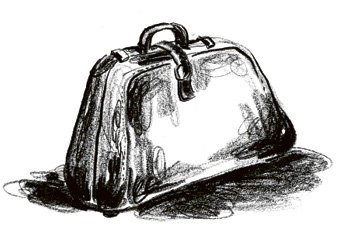
This is the first time I’m hearing of this, but it makes me feel a bit better. The news that me and sweet Jesus are born on the same day calms me instantly.
Biya bids her farewells and walks out, but not before telling me, in front of everyone: “And you behave and listen to your teacher.” She gives me a fat, wet kiss on my already wet hair and leaves. Teacher Coulson shows me where to sit and reluctantly I pull the big bag up to my seat.
My heart is beating in my throat. I refuse to lift my head. I am focused on my ashy feet. “Charmaine,” the teacher calls out. I jerk out of fright. “Would you please stand up for us?” Without looking around, I stand up slowly. “Class,” I hear her say, “this is Charmaine, and she shares a birthday with sweet Jesus. Give her a round of applause.”
Gentian violet
Gentian violet A potent topical antiseptic and antifungal dye used to treat skin infections like thrush, ringworm, and athlete’s foot, as well as minor wounds. Also known as crystal violet, it stains the skin purple where applied.

Derre This means ‘Daddy’ (most likely to have evolved from ‘Dada’ to ‘Deda’ to ‘Derra’ to ‘Derre’). It is a very regionally and culturally specific pronunciation.
That year we don’t go back to school. Edie keeps house, and we help out where we can. Derre is drunk, every night; he drinks all his money away. He does nothing he has promised to do anymore. Amma says he doesn’t even give her money for food and she is struggling to stay afloat.
Food is so expensive and with the little money she has, it is goddamn impossible to keep body and soul together. At first there is very little to eat – and then, suddenly one day there is nothing to eat at all. Derre pays his utility bills, but that’s about it. And every night he wants his food. Amma makes sure that we have something to eat before we go to sleep. Even if she must wake us up to eat.
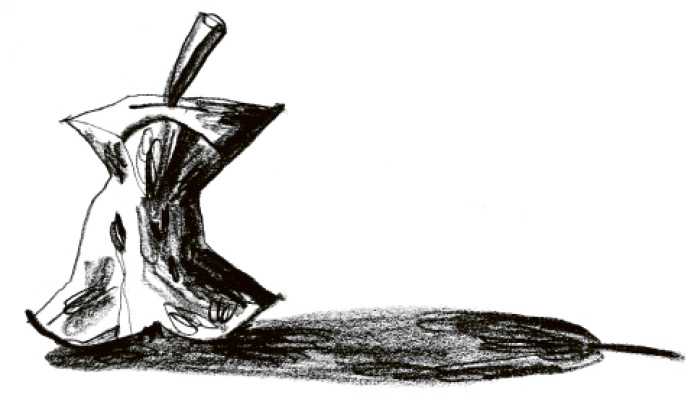
We don’t depend on Derre anymore; we also don’t ask for food money anymore. “Ask your whore of a mother,” he says when we try. Me and Kennet now walk to the station at five o’clock every night to wait for Amma. Her train comes in at seven. Our stomachs are screaming with hunger. Kennet sees a woman throw away the core of an apple and nudges me. We wait until the people have passed, then we pick up the core. I dust off the sand on my dirty dress, break it in half, and we eat. We make it a habit to walk after people eating fruit, so as to eat their discarded cores, even picking up orange peels to eat.
Goddamn The word in the original is ‘godsonmoontlik’ which translates to ‘godly impossible’. The sentiment conveyed here is how insurmountable the task is. Godly in magnitude. Imposing. Overwhelming.
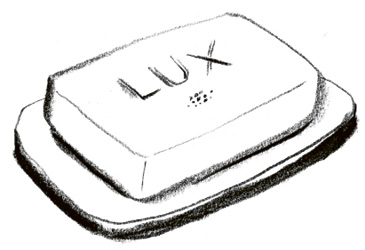
The small bar of Lux soap that Amma buys to wash us also doesn’t last long anymore, because we also wash laundry with it. Very soon there isn’t even enough money for soap, and we wash ourselves and the laundry without soap. The hardship is now starting to show, because we are now becoming vylgatte.
Vylgatte Literally ‘dirty-arses’. Words in English that capture or describe poor hygiene like slob don’t convey the meaning here: a pejorative sentiment rooted in the shame of not washing your arse – the most important place to wash. There are also overtones of the English word ‘scoundrel’ to this word.Amma has become old in a very short time, she looks tired and speaks little. The primus stove also gave up, and refuses to work anymore. The charcoal stove is still there, but getting wood is the problem. Amma starts to break up the wooden floor for firewood. The whole house is pitch black due to the smoke and smells like tar, the tar that holds the blocks in place on the floor. We don’t care anymore. The tar smell has become the nicest smell in the world. Because when you first get a whiff of that tar smell and your nostrils are black, you know tonight there will be food.
Me and Kennet have pimples all over our bodies. “Teenage acne,” says Amma. David must take us to the district Sister. The district Sister gives us one look and says: “Scabies.”
| In 1966, the racist policies of apartheid – literally ‘separateness’ in Afrikaans – were firmly embedded in South Africa. The African National Congress (ANC) leadership was exiled to Zambia. Nelson Mandela was in jail. Prime Minister Hendrik Verwoerd, considered the architect of apartheid, was assassinated in parliament in Cape Town that September. In December, apartheid was declared a crime against humanity by the United Nations General Assembly. But South Africa’s international isolation was only beginning. Neighbouring Mozambique and nearby Angola were still under Portuguese colonial rule. Zimbabwe was ruled by a white government, which had, the previous year, unilaterally declared independence from British control. What is now Namibia was then South West Africa, ruled by South Africa, despite a UN resolution in 1966 ending its mandate over the country. |
“A fancy name for help-me-scratch,” says Aunty Valerie, who came to check up when she heard Derre didn’t come home. Very soon the pimples turn into sores. It itches everywhere: my body, my head, everything. Kennet doesn’t have it as bad. I’m really suffering; and then there are the lice on my scalp, crawling out from behind my ears.
Derre is still in his own drunken world, where a wife and children do not exist. Christmas is on Sunday. Derre doesn’t come home anymore. It’s Friday, I am lying in bed, scrubbed raw and smeared purple with gentian violet. Friday no food, Saturday nothing; we are weak from hunger. Everyone is lying down, Amma too. Christmas morning, nobody stirs. We don’t even know what time it is.
“It’s Friday, I am lying in bed, scrubbed raw and smeared purple with gentian violet”
There’s a knock at the door. Nobody is bothered by the knocking. The knocking grows louder. “Tillie!” shouts an unknown woman’s voice. Amma’s face brightens. She struggles to get up and open the door. I get up with her. She hangs a little on the door before unlocking it. “Don’t you want to open the door for me?” the woman asks angrily. “God Tillie, look at you. Where’s Josef? Where are the children?” Amma gestures to the room where the others are still lying down. She isn’t in the mood for talking. The aunty goes right into the room. “Lord have mercy, what’s that smell? Open the windows. You there, what’s your name?”, she asks Baby. “Get up and let light into the house.” Because Baby is the biggest, she probably thinks he is the eldest. She’s already on his case. “What’s going on here?”, she asks again. “Ask your cousin,” says Amma. “He has not come home in all this time. Left us just like this: without money, without food, or anything.”
“Heard something like that from Marius, so I decided to bring you some food. You have to pull yourself together,” says the woman. “Leave the bastard.”
She sees me for the first time. “And this one with the beautiful hair, why is she smeared purple like this?” Amma doesn’t answer. I think she’s getting tired of the many questions now. “I’m here now,” says the woman and jogs out to her car. She returns quickly with dishes of food that the driver of the car helps her carry in.
“You all must enjoy,” she says, “I have to be on my way again, still have to go and greet many people.” Amma never bothered to tell us who she was. All we know is that she’s Derre’s cousin. The table is laid with roast chicken, potatoes, vegetables, curry, rice, salad, and even a pudding. Just like the pictures I saw in a book. We can’t enjoy the food. Every spoon you put in your mouth automatically comes back out. Our stomachs don’t know food anymore. It took three days to eat all the food.
Klawejas
On Friday night Amma comes home after visiting her sister.
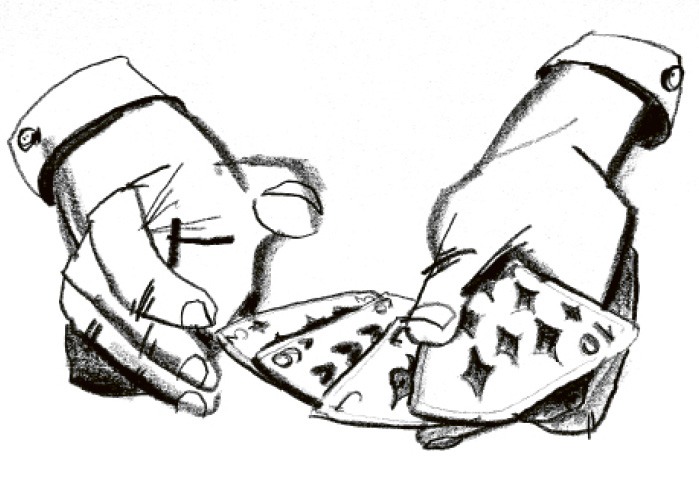
It’s klawejas night again and the wine is flowing freely. Why did she even decide to come home on a weekend? I stand around and watch them play. I like klawejas even though I don’t understand it. Halfway through the game Leon, Derre’s partner, has to go home. Derre doesn’t have a partner. Out of the blue he asks me if I’d like to sit for a game. “I don’t know how,” I answer.
“Just come and sit,” he says: “You’re a smarty-pants. You are my partner, just watch how I play.” Derre teaches me everything about the game. He teaches me to count the cards too. Best is, there are some of them who have been playing for a long time, but they can’t count, they are bystanders to the action. Derre plays very well and we are on a winning streak. We don’t get up from the table. “I have a partner for life,” says Derre.
There isn’t an argument tonight. Funnily enough, everyone is drunk, but they are decent with it. Derre and I lose eventually and I go and sit with Amma in the room for a bit. “Why did Amma come today?” I ask her.
“I got a lift,” she says, “so I took it. Can’t keep Kennet out of school any longer; he’s not so bright anyway.”
While Amma talks I am thinking about what Mister Botha always says to Kennet: “Why can’t you be like your sister?” I hate the comparison. Teachers can be so – unnecessary. But I don’t feel that bad for Kennet, he has shitty ways sometimes. It’s our turn to play again.
“Where is my partner?” shouts Derre. “Samyn, partner, come so that we can give these ones a good hiding!”
Amma looks at me with big eyes. “Are you gambling with your Derre and the others in my house?” she asks. “Then you’re probably drinking with them too!”
“You’re wrong, Tillie,” says Derre.
“Shut your mouth,” says Amma. “You have never been an example to your children. Do you also want to introduce your 13-year-old daughter to gambling and drinking?”
“And you are a spoilsport,” says Derre. “The kids are enjoying themselves with me and now you are jealous. You must stop running to your family and listening to their bullshit. They drink just as much as I do, even more, but that’s fuckall,” scolds Derre.
The whole evening has been spoiled. Amma was very wrong to carry on like that, I think to myself. What Derre said about her family is true. Why don’t they worry about their own households? Her brother didn’t speak to his wife for years. But they don’t talk about that. And he has the nerve to say that Derre gives his sister a shitty life. But how about what he’s doing? How’s that for a shitty life for his wife?
Amma is aloof towards me; Ola can’t pass without having something mean to say. Derre, through all his drunkenness, still sees what’s going on. “Don’t worry my girl, one day your prince will come,” he says.
Masterpiece
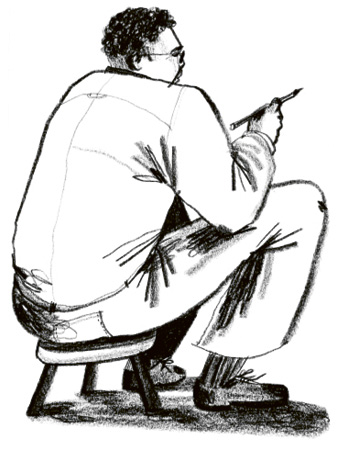
David paints every night. He is even more distant from us than usual while he’s doing it. Tree got little tins of paint from work. They wanted to throw it away, so he brought it home instead.
“A big mess,” Amma says.
But David thinks differently. “Can I have it?” he asks.
“Okay,” says Tree, “but you’re buying me a bottle on Friday night.”
David doesn’t even answer – he is so completely engulfed in his own thoughts. The next night when he gets home, he pushes the lounge chairs away from the wall. He mixes a few colours and starts painting on the wall. He quickly loses himself in the paint, he even uses his finger as a brush. He works late into the night. When he is finished for the day, he says to Mona, “Don’t let the children mess around in here tomorrow.”
Every evening, he comes to do a little more. Nobody takes note of him until what he is doing starts taking shape. Derre insists that he’s just making shit up in his head. “Leave the boy,” says Amma. We peek in now and then, but it looks like nothing. “Maybe your Derre is right,” says Amma and we laugh at the way she says it.
After nearly a week he is almost done and what we see is hard to believe. It’s a painting of a woman with long black hair, cascading over her body. We tell everyone about it, and they all come and look. “A masterpiece,” says Uncle Noah. And what Uncle Noah says is law to us. I tell everyone at school that my brother painted a masterpiece. We don’t know what a masterpiece is, but we pretend we do. Everyone wants David to paint something on their walls, but he always says no.
One day, a white man knocks on the door. They drive around in townships like this and buy people’s antique furniture for next to nothing. Even as his feet crossed the threshold into the house, he wanted to know who did the painting.
Amma says it’s her son and so he wants to meet David immediately. “This boy can go far, and I know just the right person to help him,” he says. He offers David an apprenticeship. Amma says she will speak to him tonight when he comes home from work. The guy completely forgets to ask about antiques – but then there was nothing for him anyway, we made fire out of everything.
That same night Amma and David speak about the white man. It’s not that she doesn’t think he should go, but she says one can’t trust these whites. At first David wants to go – no one asks that many questions if they aren’t interested. Then suddenly he decides against it. And after that, nobody can persuade him. After that, he doesn’t paint again for a long time.
Garlic polony
Amma receives a phone call at work. She has to come home. Baby has been locked up. He is being held in the cells at Parow Police Station. Amma comes home immediately and asks Missus Lancaster to go with her to the station. She knows where it is and how to handle things. She has to go and fetch Theo and Barney there routinely.
The charge is that Baby whistled at a white woman while on the company truck. She opened a case against him because it is beneath her that a hotnot whistled at her. She wrote down the truck’s registration number, and then they came to pick him up at work. According to Baby, he whistled at her because she was standing in the way of the truck and ignored the hooting of the driver.
A court date is set. When he appears he is found guilty of… God knows what. He has a choice – either corporal punishment or a fine. Amma can’t pay the fine, so he gets six strokes of corporal punishment.
On the way home Baby can barely walk. “I fucking hate white people,” he says, and I agree. “Fuck white people and their mothers,” he adds. We almost walk through the WHITES ONLY subway at Parow station out of anger.
A young Boer bitch says: “Can you people not read? There, it says,” and she points with her finger to the board: WHITES ONLY. I get such a fright, because we could go to jail for this.
“Yes, only white fuckers and pigs!” I shout back.
Amma yanks me so hard that I fall. “What is wrong with the two of you?”, she says, “Do you want to go to jail? And listen to the foul language.”
“Sorry,” I say.
It’s the first time I’ve sworn in front of Amma and I feel bad. But that white pig brought out the worst in me.
“I am going to show these white pieces of shit something nasty,” Baby says.
All that Baby and I can talk about the whole way are those white pigs. “Then they’re not even really white,” he says, “they’re fucking red as garlic polony.”
Amma loses her temper. “Tonight, we will all die in the cells, can you two not keep your mouths shut?”
“Nah,” I say, “I first want to kill a Boer.”
Baby lets out a heavy laugh. Amma grins along with him. “If you two are not going to stop with these bullshit stories, at least speak softly,” she says.
She is just glad everything is over and that Baby didn’t lose his job at least. “You must not even look in their direction when you’re working,” says Amma. “Just do your work and wait until they are out of your way. Don’t ask them to move out of the way.”
I am getting very pissed off by these white pigs that have my mother’s nerves in such tatters. “Yeah,” I chime in, “don’t talk to them or look at them, spit over your shoulder into their white Boer snouts.”
Reproduced with the permission of Tafelberg, an imprint of Jonathan Ball Publishers.