Behind every translation there is a translator, a place where translation happens, a dictionary (possibly several), a lived experience of translation or working in and between different languages.
We want to highlight the work and processes of one translator, interpreter, or those working in multilingual environments by flicking through their notebooks, both real and metaphorical. In our first issue, we asked Paul Russell-Garrett—a leading literary translator from Danish, Norwegian (and occasionally) Swedish—to open up his notebooks for us.

I have been thinking about this quote for some time, so when I was asked for a contribution to this exciting new translation initiative, the idea had already been simmering away in my mind. There are just so many elements to it and I can picture the image perfectly, I can almost see the narrator stirring the pot, can almost hear the clattering of the lid, see the steam rising, the wooden spoon scraping the bottom and banging against the sides.
In this opening passage from my translation of Christina Hesselholdt’s Vivian, the narrator goes on to list all the traditions this family of immigrants follows when they celebrate Thanksgiving, going on to say that for them, the turkey dinner they are cooking IS Thanksgiving. Well for me, the opening sentence IS character development—put your pot on the stove, add all the ingredients, let them stew for as long as possible, checking them along the way—tasting and seasoning to make sure it is just right, before repeating the process over and over again.
The quote from Christina Hesselholdt is an enduring image and one of my favourite lines from any of my translations. As I develop my skills as a translator, character building is something I’ve been focussing on of late, and this seems the perfect allegory for what I’m trying to do. Being a translation, the author has already constructed this character, but my job is to break it down and build it back up again in a way that makes sense in its new context.
I’m reminded of some advice I was once given—to jot down any words, thoughts, quotes and ideas on scraps of paper and pop them in a box so I can use them in the future. Well, now I’ve got notebooks full of these reminders, though I rarely look through them. I have tried using a digital notebook with limited success. My latest effort is to pop the notes into a glass jar that sits atop my translation cabinet—where I keep all my dictionaries, reference books, notebooks and other important papers.
The jar is see-through, refuses to be ignored, demands to be filled and emptied and filled again. It has no lid, so I can pop a note inside or take one out, I can even read some as I walk by. The jar reminds me, gently and persistently, of the qualities I am striving for as a literary translator—self-aware, self-taught, self-reflective, self-improving and self-starting.
And now it’s time for me to poke my hand inside, stir them around a little and see which ones are ready for me to use.
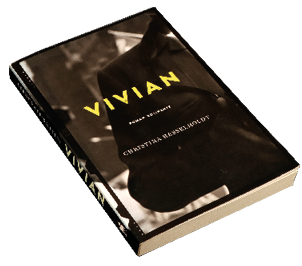
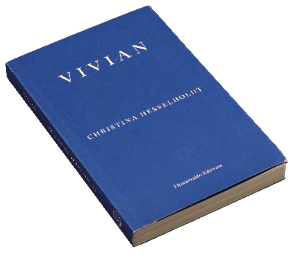
Vivian is a novel by Christina Hesselholdt, first published in Danish in 2016; translated by Paul Russell- Garrett into English in 2019 for Fitzcarraldo Editions.
The book is a fictionalised imagining of the life of outsider artist Vivian Maier, who worked as a nanny for rich families in New York and Chicago, while quietly chronicling the world on the streets around her with her Rolliflex camera, a different kind of translation —movement to stasis, three dimensions to two
Her collection of 150,000 photographs only came to light at an auction shortly before her death in 2009
—an extraordinary black-and-white archive of mid-century America.