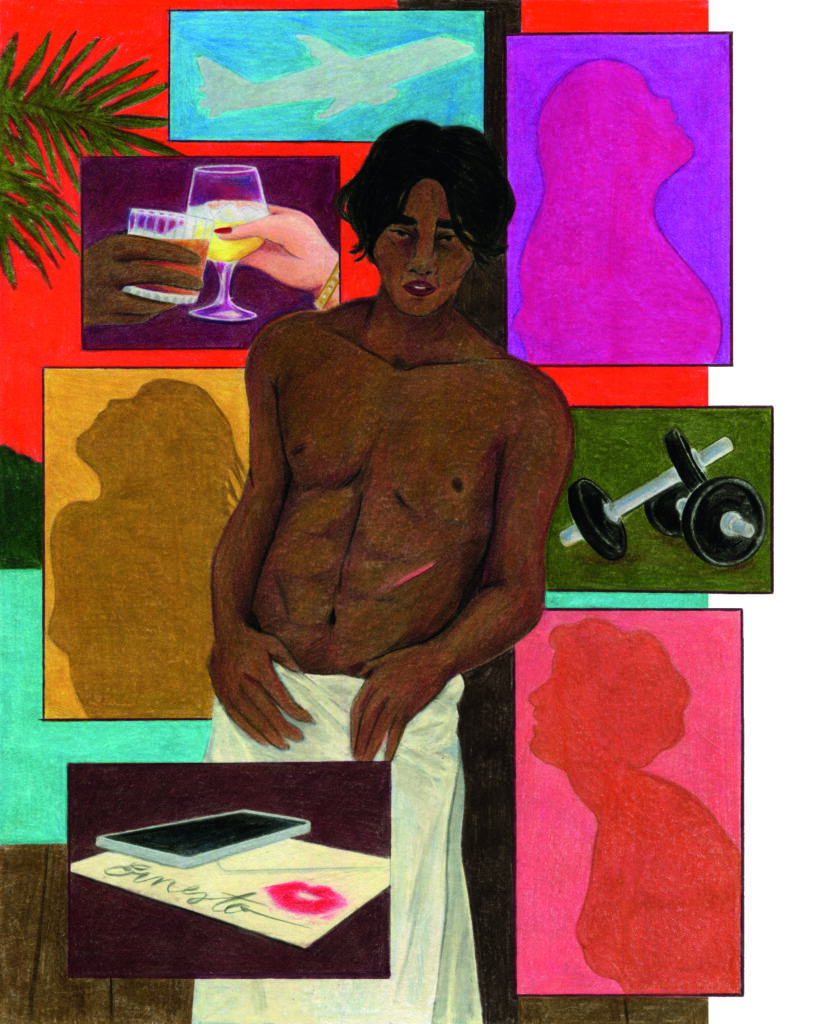
I t was a rainy afternoon in Viñales, and Ernesto had the Italian woman naked on the kitchen counter in her rental house when his iPhone started to vibrate. It was the French woman calling.
Earlier, following lunch, Ernesto had come up behind the Italian woman as she washed the dishes, pressed his bare, muscular torso to her back, and softly kissed her neck and shoulders, then turned her around and undressed her. He’d completely forgotten about the French woman, who’d emailed the previous day, saying she’d arrive in the morning and had arranged to introduce him to her Cuban relatives that afternoon. Ernesto made an excuse and left the overexcited Italian woman on the counter. He went into the bathroom, and answered his phone, “Salut, mon amour. Est-ce que tu est arrive bien?”
“I made it, mon amour. When are you coming to Havana?” “Aujourd’hui, ma chérie.” It was the Italian woman’s last day in Cuba, which was a problem.
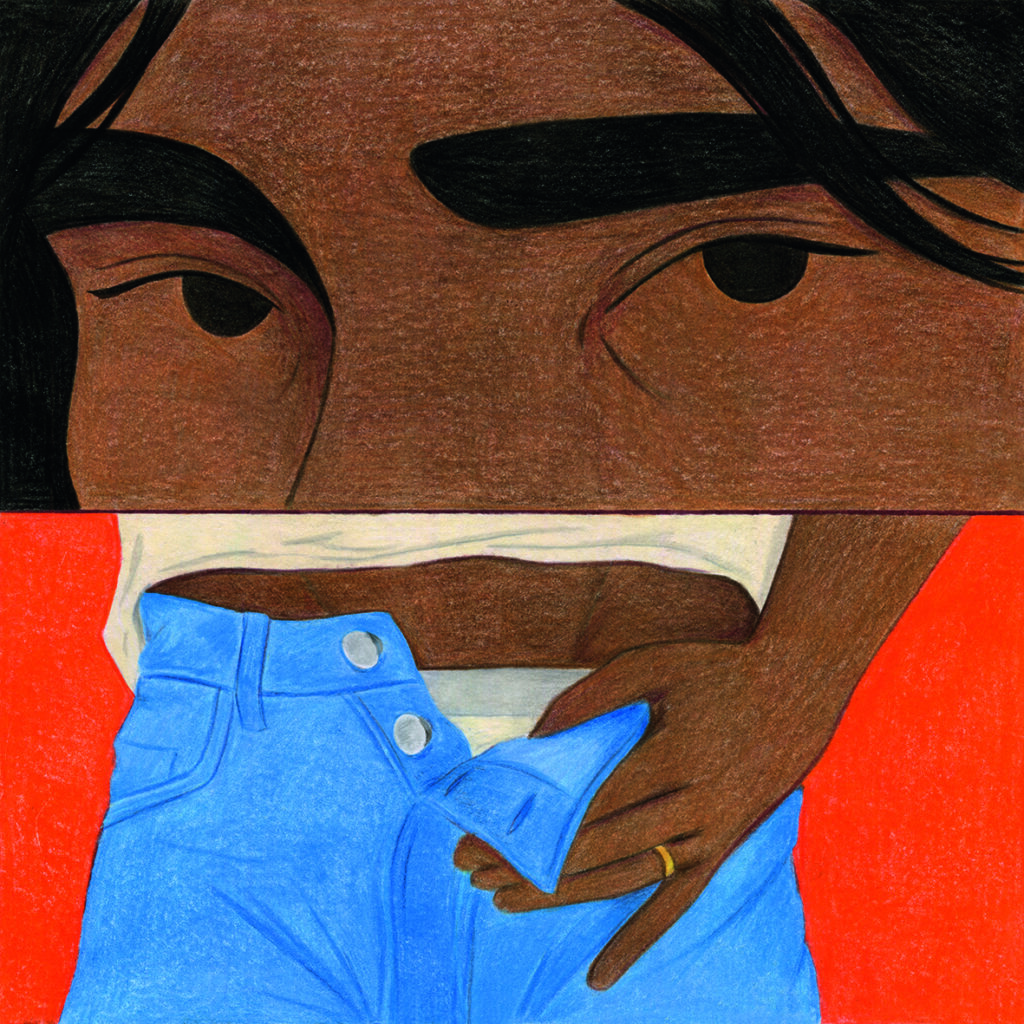
Ernesto returned from the bathroom and, as if nothing had happened, knelt and kissed his way from the Italian woman’s feet up to her face.
Round four
isn’t a literal translation— it’s a colloquial American way of putting this that, to me, helped get the narrative into a properly casual voice
He’d already had sex with her three times that day. After round four, he said, “My sister called. My mom’s sick again. I have to go to Baracoa.” It was two in the afternoon, and Ernesto was drained and slick with sweat. The Italian woman stretched out among the knives and frying pans, as if the counter were a waterbed.
Ernesto and I first met in Guanabo, a resort town east of Havana. The town has rough, hard beaches, but we were at a house with a pool, which had been rented by the mother-in-law of a friend of Ernesto’s. She’s Cuban, married to a French Congolese man; they split their time between the Republic of the Congo, France, and Miami, but she comes home once a year to Cuba to see her daughters and mother. Her husband’s niece, Fadih, was the French woman who had called Ernesto.
Fadih was born in Brazzaville. She’s thirty-three and weighs nearly 300 pounds. She wears glasses and has very dark skin. She and Ernesto had met four months before the phone call, while she was in Havana for her cousin’s wedding. “I snagged Fadih at the airport,” Ernesto told me by the pool. “I’d just dropped a Spanish girl off there. Fadih had never visited Cuba before, and the second she walks out the door, here I am. A sign, right?” He interrupts our conversation to get up and dive elegantly into the water in his tight, highlighter-yellow trunks.
Game face
In Spanish, this is “cara de seductor,” or “seducer’s face.” Not a phrase anyone would say in English conversation!
Fadih’s visit was supposed to just be for the wedding. Instead, she spent two months on the island after bumping into Ernesto at door four in arrivals at José Martí Airport. “I saw her looking around, all confused, and bam! Got her address, got her number, got my game face on,” Ernesto continues after he gets out of the pool. He called her every night, and loitered around her relatives’ building until she appeared. One day, he invited her to join him on the Malecón (a long seawall that runs along the coast of Havana which is a popular destination for locals and tourists). She drank beer; he drank juice. “I lucked out,” he says triumphantly. “None of my other girls were there, so all I had to do was bag her.” And bag her he did. She changed her airline ticket and let him show her around Cuba. After visiting cities and beaches all over the island, he brought her to Baracoa, in Guantánamo province, to introduce her to his mother. “Bringing her home was a good move, but I know the drill with foreigners. I give them pretty Cuba, pretty me. Baracoa was about convincing her that I wasn’t just playing, that I was in it for real.”
Hustler
This was a tricky word! I could have chosen “gigolo” or stuck with “prostitute,” but neither quite seemed to capture the work involved. Nor did they have the active spirit of the original verb, “jinetear,” which, outside Cuba, means “to break horses”
When the USSR disintegrated in the early 1990s, Cuba went into an economic freefall. Without the handouts from the former Soviet Union, the Cuban economy cratered. GDP contracted by 36 percent, and the crisis ate up the welfare programs that the Revolution had created. This crash reverberated throughout society. For example, between 1990 and 1995, the average adult Cuban lost between 5 to 25 percent of their body weight, according to state economic studies. Fidel Castro called this time the “Special Period.” Survival became difficult, and once clandestine ways of earning a living, such as prostitution, burst out into the open. As the government turned its back on the populace, the modern Cuban hustler was born.
Ernesto’s family barely made it through the Special Period. His father had died of a heart attack when he was eleven, and after his mother lost her state job in one of the massive layoffs, Ernesto had no choice: he had to earn a living. He quit school at fourteen and joined a gaggle of local teens who spent their days in the center of Baracoa, hustling for money from tourists.
Ernesto didn’t tell his mother what he was doing. Instead, he let her continue waking him at 6:30 a.m., dressing him in his pioneer uniform with its red bandanna, and putting his stuff in his backpack, which he hid, along with his white shirt and scarf, in a crumbling, abandoned two-story house. Unburdened, he’d head to the hotel district in historic Baracoa and get to work. “Mami didn’t guess until I gave her a whole crate of ham and cheese and soda, and some American coins, and there’s only one way I could’ve gotten those. But what was she going to say? If I hadn’t started bringing home food, we’d have died of hunger,” Ernesto says, not laughing. I’ve never seen him this serious before.
Ernesto graduated from scavenging gum and sandwiches from tour buses to recommending restaurants in the historic center, in the process earning commissions from the proprietors. Instead of begging for American coins, he sold Cuban currency, highlighting Che and José Martí’s portraits on the bills. But he was still just scraping by. He saw only one way to earn real money: seducing foreign women. “Foreigners come here for us,” he told me by the pool in Guanabo, his back to Fadih’s Cuban cousins. “It’s the truth.”
Man
Ernesto says “man” in English in the original, so it was easy for me to keep his voice here!
He started having breakfast in hotels and fancy tourist cafés, but that ended up draining his savings. “It wasn’t the right energy,” he says. “I wasn’t going to get their attention unless I looked Cuban: rum in my hand, hips moving, whistling at them. And that’s not the cafés. It’s night, in a club.” He started exercising and claiming he was in college, studying physical education. “No one wants a moron, man,” he tells me. “I’m hot, I’ve got the build, I’m the right color for them, but that’s not enough. I read the paper, put the news on. Women like it when I talk to them about the world.”
During the Special Period, many poor Cubans began to see tourists as goldmines. To them, one visitor to the island was a steady income; a group, a business. Castro tried to stifle this budding industry by banning Cuban citizens from hotels and tourist attractions, an infantilizing, authoritarian reaction, like sending your child upstairs when you have guests. It thus became challenging for Cubans to meet foreigners. It wasn’t until 2008 that Raúl Castro relaxed the laws.
Now, anywhere you go on the island, you see couples, one Cuban and one not, that are obviously sustained by practicality rather than love; couples that you can immediately tell are together because one likes the other’s wallet. Maybe it’s a stylish older woman holding hands with a charismatic Black man in his twenties, a muscular guy, probably a good dancer, with dreads or braids; maybe it’s a gray-haired man blowing cigar smoke at a slim brown girl with long curls and full lips. These hustlers congregate in touristy areas and at the chic bars that are popping up around the island lately. Charm and Cuban stereotype are their bait; foreigners swim around them, eager to swallow the hook.
“Sometimes his payment is a pair of flip-flops. Sometimes, an iPhone. Donations, tax-free. And if the client’s content with the services rendered, if the affair is steamy enough to continue online, then who knows?”
Ernesto is a nomad. He drifts from Eastern to Western Cuba, hotel to hotel, rental to rental. If he’s in a private home, it likely belongs to friends of his clients. If he’s anywhere else, the client is paying. He religiously sends much of the money he earns to his mother in Baracoa, never skipping a month. She’s sixty-six and strong as a draft horse, and invests the cash in her coconut-candy business.
Still, Ernesto hasn’t been home to Baracoa in over a year. He says he won’t return until it’s time to say his farewells when he’s leaving Cuba for good. He can’t stand living in poverty anymore.
A month after we met in Guanabo, Ernesto told me he was in Havana, and we met at Café Maimanés, in Vedado. Fadih was in Paris. He’d just come from Varadero, where he’d said goodbye to a woman named Judith, who was flying back to Germany; in the morning, he was picking up an English woman at the airport. He said that he planned to spend the night alone in a rented room in Miramar, an upscale Havana neighborhood, then collect the Brit and take her to the same hotel in Varadero that he’d left with Judith less than twenty-four hours before.
“I’m a professional,” Ernesto tells me, smiling. “I’ve got tons of competition, so I have to focus. Set myself apart. Stay in shape. I’m not vegetarian, but I mostly eat greens. I don’t eat fat or drink beer. Rum, whisky, beer only if I really have to and the girl’s worth it. But I don’t swallow. I just kiss the glass, get some foam on my lip so that the girl can taste it.”
When Ernesto isn’t busy with his clients, he’s at the gym. He prefers planks, pull-ups, and bars to lifting weights. He does lots of abs, and he runs, but not too far; he can’t risk getting scrawny. At thirty-four, he looks like a gymnast, all streamlined muscle, a body designed to appeal to all sorts of women: white, Black, Latina, Asian, short, fat, thin, tall. He’s at your service, up for anything, a mannequin on constant display.
When Ernesto catches a woman’s eye, it means he gets free dinners, beach days, nights in air-conditioned rooms. It means commissions from the hotels and restaurants he takes her to. It means selling her marked-up rum or tobacco. And at the end of her trip, it means taking home some items or clothes. All very subtle, but it’s business, and the women are generally well-aware of what’s going on. “We don’t have to discuss it,” he says. “No contract. Usually, the girls get it, though some poor things don’t see the bill coming till it’s time.”
Sometimes his payment is a pair of flip-flops. Sometimes, an iPhone. Donations, tax-free. And if the client’s content with the services rendered, if the affair is steamy enough to continue online, then who knows? All Ernesto’s efforts could end in a wedding and a new life. In any country. He doesn’t care which one.
Ernesto’s body is perfectly chiseled. His skin is brown, his eyes slanted. His curls brush his solid shoulders. On the left side of his six-pack is a knife scar from a prison fight.
Cocky
Did I intend this as a bit of a pun? Maybe!
He says he last ate bread fifteen years ago, and now he feels sick at the sight of it. “I haven’t touched that shit since jail. I did three years for prostitution and harassing tourists”—both illegal in Cuba. He was incarcerated in Santiago’s Boniato Prison, melting in his narrow cell in the summer, missing the sunlight in the damp winter. “I wasn’t scared of the cops in Baracoa. I knew them and they knew me. But I got cocky. I was coming out of a club with a Brazilian girl who was wild for me, really nuts, and the pigs grabbed me and tossed me in the car without a word. Judge, jury, and three years, bang! I lost the Brazilian girl. I was living with bad guys, man, really bad guys, and I was only twenty-one when I went in. I got this scar fighting two guys who wanted to rape me. I had to get tough.”
“And you didn’t learn your lesson?” I ask.
“Man, you’re looking at it the wrong way. I came out of there stronger, more focused, ready to grab every girl who might get me out of this piece-of-shit country someday.”
Ernesto ended up ditching the Italian woman in Viñales. “She was leaving anyway, and we were just partying. She wasn’t going to marry me. She’s not my ticket out of here.”
He then headed to Guanabo, where Fadih and her family were waiting. In front of their house, he got nervous, as this was a Cuban family, not his usual audience. “Cubans can spot a hustler, but who cares? No fear in here,” he told me, thumping his chest. “I’ve just got to show them that I’m a catch.”
Fadih’s family couldn’t believe she hadn’t picked up on his game. “I overheard her aunt saying, ‘If she gets him out of Cuba, he’ll disappear the first time he goes for a walk.’”
However, her cousin defended him, “So what, Ma? Where’s she going to get another guy that hot?”
Fadih’s face was radiant with pleasure. Ernesto whispered in her ear, and she smiled and caressed his neck. Her relatives stared at him, incredulous, as he ate, talked to Fadih, dove in the pool. “Sure, they’re protective. Any Cuban would be. But I’m not scared. I didn’t get into this game yesterday. I’m good at my job, and that’s what matters. I’ve got that girl in love with me.”
“ I came out of there stronger, more focused, ready to grab every girl who might get me out of this piece-of-shit country someday.”
During our conversations, Ernesto never sets his phone down. He’s got a ton of contacts. “All this is from years of work,” he tells me, holding up his iPhone to show me the female faces in his WhatsApp chat. “And it takes work still. I sit down with my email, Facebook, calendar, check dates so that my girls don’t overlap. I don’t hunt for more. I’ve got mine. I don’t need to compete. I’m good.
“It was hard at the beginning because I was shy, but you can’t stay shy in this game. What you do is, you attack with your eyes. It gives you a starting point. If a woman really looks at you, or if she looks away and then right back, you’ve got her. Easy. Write that down. After that, it’s just chatting, inviting her out, getting ahead with her so that later, at the bar, you can order, order, order without worrying that she’ll give you the check when it comes.” After the bar is when the real work starts. “All the warm-up,
I do on autopilot. No problem. What still takes work is the sex.” According to Ernesto, women visit to Cuba for the Caribbean heat, and they’re merciless about it. Sex at night, in the morning, before lunch, after lunch, in the shower, in the kitchen, on the ground, against a tree, in a bush, on the stairs. “You’ve got to drive them nuts, man. Six, seven, eight times a day. Only a Cuban can do that.
“How? Using my mind. I concentrate, man. I focus. I’m professional. It’s sex, yeah, but I don’t care about her tits, none of that. I’m asking myself, ‘What’s she going to remember later?’ Every single thing I have in this world, I owe to my dick, man. That’s the truth.”
Ernesto trained for his role, in a way his roster of women couldn’t possibly imagine. “You’re not ready till you’ve fucked a chicken, man, a pig, a goat. Animals have hotter pussies than women. Any farm kid in the east knows that. If you want to learn to control yourself, to not come fast, you go make a chicken scream.”
I asked, “Do you know how many foreign women you’ve had sex with?”
“No, man. I wish. My buddy asked the same question, and I couldn’t even guess. I should’ve counted. But I can tell you it’s a high number, since I’m not picky. She’s just got to be foreign. Fat or ugly isn’t a problem. It’s good, really, since those girls need it more.”
The following summer, Ernesto spent a week at home in Baracoa. He didn’t bring anybody with him. His mother says he only went out during the day to use the free internet downtown. Otherwise, he just sat by the living-room window, thinking about his father, spinning his new gold ring.
French Girls
In the original, “French woman” and “French girls” were just "francesa" and "francesas," but in this paragraph, I chose to end on “girls” not only because I didn’t want to repeat “women,” but also because it matches Ernesto’s dialogue throughout and, perhaps, evokes the immaturity of the relationship, which, after all, hasn’t had any time to get itself on equal footing (and may never: we don’t know)
“He said he’d come to say goodbye,” she says. “He told me he’d married a French woman, and he was leaving the country. He’d brought her to meet me the year before, but I really don’t remember which one of the French girls it was.”
Translated excerpt from The Hidden Island, Ig Publishing, 2025