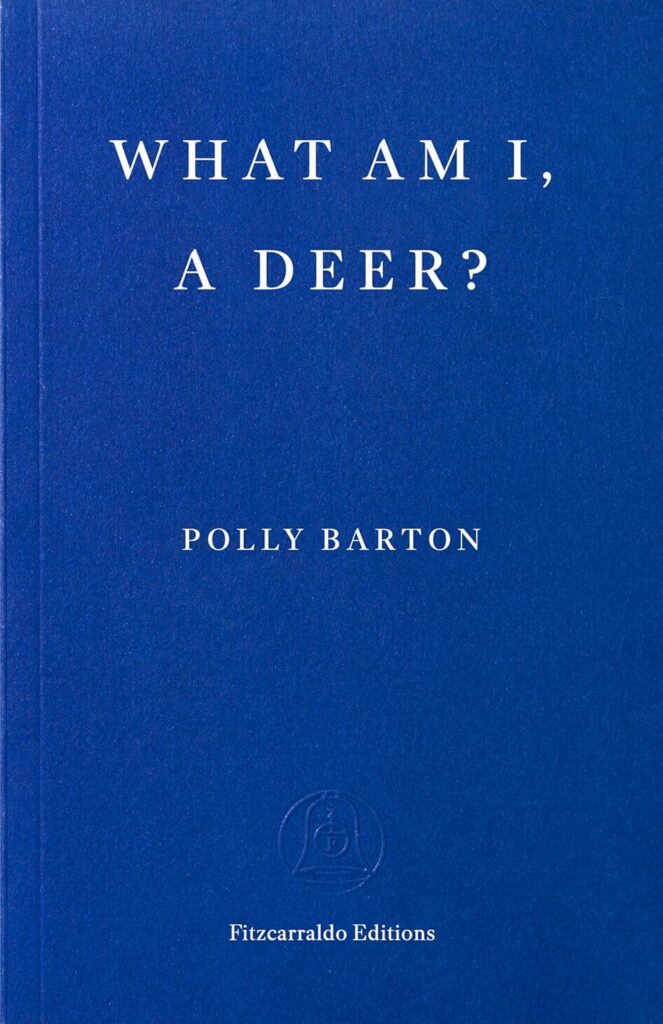
By Polly Barton (Fitzcarraldo Editions, 2026), 248 pages
Reviewed by Odhran O’Donoghue
Early in What Am I, A Deer?, Polly Barton’s wonderful debut novel, the protagonist reflects on one of the central debates in literary translation: whether a translation should hem as closely to the source text as possible, to retain its cultural and linguistic specificity, or adopt a more experiential approach that aims to replicate the sensation of reading the work in its original language. For the protagonist, successful translation is defined by the skilful balancing of these two opposing demands, but is a near-impossible task, with one nearly always taking priority over the other. This tension, inherent in mediating between two seemingly antithetical positions, animates Barton’s novel. It operates not only between languages, but also between the inner and outer self, fantasy and reality, conscious and unconscious desires. In tracing these intersections, she reveals the notion of stable, immutable identity, much like the mythical perfect translation, as the fantasy that it is.
Barton, an established translator of Japanese fiction, is best known for her work on Asako Yuzuki’s hugely successful Butter. She is also the author of two works of non-fiction: Fifty Sounds, a memoir that recounts her experiences of living in Japan and learning Japanese via an exploration of onomatopoeic words, and Porn: An Oral History, a collection of interviews with nineteen acquaintances about porn (both their personal relationship to it and their views on it as a form). Superficially, What Am I, A Deer? would seem to have more in common with the former – its protagonist, a young British woman who has relocated to Frankfurt to work as a Japanese translator for a video games company, shares more than a few biographical details with Barton. But the genesis of the latter book lay in Barton’s fascination with how, despite porn’s ubiquity, discussion of it, even with close friends or partners, still felt taboo. This gap between our actions and how we understand and narrate them, or more specifically between what we say or think we want, and what we actually want, is also at the heart of her novel.
Barton has cited queer theorist Lauren Berlant’s Cruel Optimism as a foundational text for What Am I, A Deer? Berlant’s 2011 work examines Western society’s enduring attachment to traditional methods for achieving success and happiness – such as workplace satisfaction and progression; monogamous, heterosexual love; and the nuclear family – despite evidence that these institutions are not only inadequate to the task but actively hindering access to ‘the good life’. Throughout the novel, Barton’s protagonist sustains various attempts to invest in these happiness scripts, only for them to fall short. While initially this plays out via her inability to find meaning in her work, or to forge anything beyond the most superficial of bonds with her new colleagues, the most prominent manifestation of this rupture between expectation and reality occurs in her romantic life.
After a fleeting, inconsequential encounter with another employee at the video games company, she develops an all-consuming obsession with him, one that threatens the already tenuous boundaries of her sense of self. Shortly afterwards, she enters into a relationship with one of his colleagues, a man who from the outset holds little interest for her, yet whom she struggles to disentangle herself from. One man is utterly devoted to her, excessively so, and, if not overtly abusive, certainly coercive and controlling. The other is hardly aware she exists, yet exerts an irresistible, almost gravitational pull on her. Both relationships are narrated in a needlingly visceral manner (the near transcendence provoked by her crush, known only as ‘the umbrella man’, is particularly evocative, effectively conjuring the totalising effect of infatuation on a cellular level). Ultimately, she knows that neither man can bridge the gulf between the life she envisions and the life she has. Rather, the failure of these diverging representations of the inadequacies of heterosexuality to resolve the narrator’s sense of being adrift, of being unmoored from herself, suggests a crisis that goes beyond her individual circumstances. What emerges is the broader erosion of meaning and connection in an increasingly atomised world, which has come to define the contemporary era.
So, where does this leave the protagonist, or the rest of us struggling to make sense of desires we barely understand, while navigating circumstances that refuse to bend? Barton offers no neat solutions (although her protagonist is bisexual, thankfully Barton is far too sharp an interlocutor to proffer queerness as an anodyne to the tyranny of heteropatriarchal capitalist alienation), but she does posit a somewhat unexpected source of at least temporary reprieve.
Throughout What Am I, A Deer?, the protagonist turns to karaoke as a source of solace, a space in which the fragmentation of her subjectivity and the opacity of her desires give way to, if not quite coherence, then something like silence. Like Barton’s other concerns in this novel, karaoke is fundamentally a liminal form, neither wholly art nor entertainment, equally susceptible to displays of both overwhelming sincerity and disaffected irony. It literalises the performance of identity, exposing the gap between the public and private self. Moreover, as the protagonists and her colleagues discuss, karaoke is itself an act of translation – one that collapses the binary between the translator’s contradictory aims of linguistic fidelity and some version of literary authenticity. The karaoke performance is neither the original song nor an alternative version, but something in between. It is polyvalent and ambiguous, and it is this refusal to cohere into any one meaning that engenders its euphoric, transformative power, allowing performers to break past social conventions and private anxieties that often block collective pleasure. Karaoke may not save the world, Barton suggests, but it might soften the noise – at least for an hour or two.