In a China racing toward the future one reluctant young shaman fights to honour the ancient spirits that refuse to let him go
Ah Lei seems to be used to telling his story. He grew up in an impoverished family in Fusui, Guangxi Province. His mother left shortly after giving birth to him. He started to fetch water and do other chores before he reached the height of a carrying pole. This wasn’t unusual – the other children in the village also started to help around the house when they were very young. What was strange were Ah Lei’s dreams: gods or ghosts came to talk to him. During the day, he would hold a piece of firewood and strum an invisible string on it while murmuring to himself. No one knew where he got this from. His classmates thought he was mentally ill and didn’t want to play with him. But Ah Lei’s grandmother knew how to deal with strange situations like this: ask the gods.
Guangxi is China's largest Zhuang Autonomous Region, home to the Zhuang people – China's biggest ethnic minority – whose ancient animist traditions, folk rituals, and shamanistic practices have survived centuries of cultural pressure and political upheaval.
Thought he was mentally ill...Ah Lei recalls his classmates calling him 脑子有问题 – literally "something wrong with the brain" – a derogatory phrase that exposes both the stigma surrounding mental health and the community's inability to recognize what was actually a spiritual calling.


Ordinary people cannot just talk with the gods: they need a spirit medium. His family found a medium for Ah Lei and she performed a ritual. Ah Lei stopped acting like before, and the family breathed a sigh of relief: they thought it was over.
But soon Ah Lei started acting strange again. He often felt muddled. Words he didn’t understand came out of his mouth. Things got even worse when he was in middle school, and he dropped out. There are only two choices for young people in the villages who don’t finish school: join the military or move to a city to find work. Ah Lei chose the latter. He went to Nanning, the provincial capital, and worked with his father on a construction site handling cargo. Within two years, Ah Lei started to act like before, only this time he felt sick all over. He ran back home and joined his aunt, working in the fields, cutting hemp and carrying firewood.
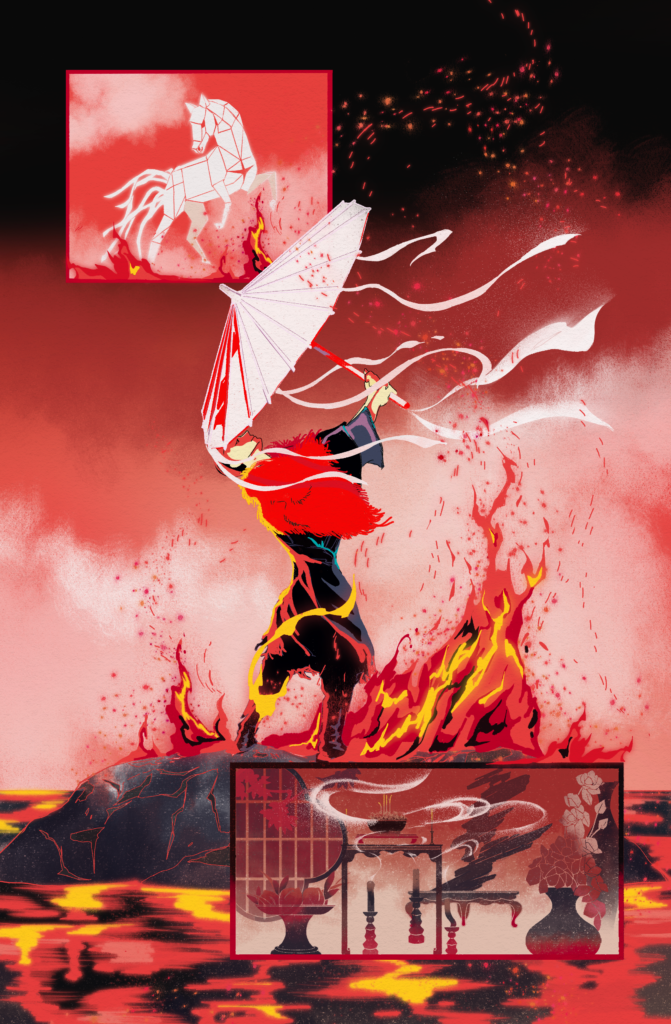
One day, he didn’t go to cut hemp. That evening, his aunt came home and found him sitting on the bed, absentminded, legs shaking, muttering incomprehensibly. It was like something had taken control of his body. He stood up, lit incense and announced that his “troops and horses” were going to Boli village to find their master.
Mediums from nearby villages didn’t think Ah Lei was possessed by evil spirits; rather they said he was experiencing chuxian出仙 (latin Zhuang ok sien; Vietnamese oòc tiên), or ‘religious ecstasy’, a term from the Zhuang language, referring to the incarnation of divine power in a human being (but more often now used when a person experiences mental illness). The villagers recalled there were mediums among Ah Lei’s ancestors. Perhaps they were choosing him as a channeler?
Oòc Tiên Latin Zhuang:ok sien. Author’s Note: Traditional Zhuang characters used along the China-Vietnam border were never totally standardized. Consequently, a single word may be written using several different characters depending on the scribe or the specific transcription. This work primarily utilizes characters from the Jinlongdong. (金龍峒) area; no traditional written scripture was found in Fusui(扶綏)area during my fieldwork.


The family was shocked. Ah Lei was only fourteen: how could he do such a thing? But Ah Lei continued to act strangely, so the family went to Boli village, where they found the medium Chen Wenhe. They asked Chen Wenhe to perform a ritual to keep the troops and horses at bay – at least until Ah Lei came of age. The ritual involved the slaughtering of a rooster, and only succeeded if its head faced the medium during this process. At the end of the ceremony, the rooster fluttered around, its head stubbornly turning towards the door. Chen Wenhe sighed. “I cannot stop them anymore. Those troops and horses are coming.”
The outcome of the ritual suggested that the Flower Mother – one of the most important Zhuang folk deities – had received the order to ordain him as a medium. Despite the reluctance of his family, Ah Lei set up an altar to be formally apprenticed and embarked on his own path of shamanic practice.

I first met Ah Lei in 2019, when I was in graduate school and interning at a museum in Nanning, not far from Fusui county. I got to know Wu Bin, a man from the village next to Ah Lei’s, who asked me to accompany him to Ah Lei’s performance of Lau Then, the ‘Heavenly Wine’ ritual. Although I had no idea what the Heavenly Wine ceremony was, as a visual anthropology student, I thought it could be a perfect subject for an ethnographic film. As we drove from Nanning, Mr Wu played music from the ‘Sea Crossing’ (過海 in Chinese; Vietnamese Tày khảm hải) section of the ceremony. My mind spun with silent questions. Do we even have the sea here?
Lau Then – A ritual of devotion and spiritual maintenance performed by Bud practitioners to nourish their spirit soldiers and honour the gods held several times throughout the year.After we swung onto a country road, the scenery outside shifted to rows of houses built in yellow mud, the walls painted with half-faded slogans: 义务教育 Yìwù jiàoyù [Compulsory Education] 均衡发展 Jūnhéng fāzhǎn [Balanced Development]. We drove through village after village, all similar to the first. Just when we started to worry that we had lost our way, a hut decorated with colourful paper-cut flowers and ribbons popped out from the thick grass.
“Look! That will be Master Lei,” said Mr Wu. I turned. Several Daoist priests in garish bedsheet-like robes stood near the hut. I was trying to figure out which one was Ah Lei, when a young man in a t-shirt and sweatpants came towards us. He looked at most one or two years older than me, with a light-coloured, pear-shaped face. His expression was straight and flat, in contrast to the yellow smiley faces printed on his slippers.
Mr Wu asked in Mandarin: “So, I’ll park the car at your place?”
“It doesn’t matter,” replied Ah Lei. Hand resting on the car window, he added, “I’ll be back in a while,” in the same emotionless voice.
The banyan trees and shrines in the village were all decorated with banners. In contrast, Ah Lei’s house was a small three-storey building with no exterior decoration. When we entered, the first thing we saw was a bed piled with miscellaneous things. Behind this room was a big hall, with shelves enshrined with memorial tablets and a square dining table on which offerings to the ancestors were placed: palm leaves layered to resemble flowers, dragon fruit, apples, bowls filled with raw rice next to red and yellow rice cakes, candies and crackers stacked delicately in red goblets, vases of fresh flowers, all kinds of liquor. Even though I was also from southern Guangxi, I felt like I was in a foreign land.
Ah Lei’s home was a bubbling cauldron of voices and commotion. Mr Wu greeted everyone in Zhuang. Before long, Ah Lei arrived. He looked unusually young among the crowd of mostly older people, but he instructed the aunties with authority to prepare the materials and food for the ritual. The villagers called him laoshi out of respect.
Mr Wu introduced me to Ah Lei. He nodded at me with no emotion. I told him, half-jokingly, that I might make a documentary about him. His hands were busy arranging the sacrifices, and he was issuing commands. I was unsure if he was listening, but he cast a careless glance at me and said, “Fine with me.”
Ah Lei paid me no more attention, plunging himself into preparations for the ceremony, leaving me stunned. Ah Lei was unlike any spiritualist I had encountered. How could I film a person like this?
Among the Zhuang people of Southern Guangxi, there are different types of ritual practitioners.
Types of ritual practitioners Three distinct roles define Zhuang spiritual practice: Taoist practitioners who cannot be possessed; shamans who channel spirits directly; and shamans who invoke possession through the tinh lute.


Whereas 道公 daogong or 师公shigong are deeply influenced by Taoism, relying on doctrinal standards and often appearing at funerals to drive away unlucky influences or to send the deceased on their way to another world, the other types of ritual practitioners can be regarded as folk shamans. They are said to commune with ghosts and gods and travel between the human and spirit worlds (although different types of shaman have different scriptures and worship different gods). Only people who have experienced religious ecstasies can become shamans. Their stories are very similar to Ah Lei’s: one day, they become sick and can’t recover until they set up an altar to be apprenticed.
Shamans like Ah Lei are known as bud (魓) or moed (末 or 麽). Bud and moed use unique instruments in rituals: the tinh lute (a gourd with one or two strings), and strings of brass rings on chains that represent a horse’s bridle (often known as ‘馬; latin Zhuang: max; Vietnamese Tày mã).
Bud and moed are regional Zhuang terms for shamanic practitioners: Bud dominates the Zuo River dialect, while Moed – associated with femininity and goddess possession – is preferred in Dejing, even among male practitioners who embody female spiritual energy.
Tính in Vietnamese Tày; 叮 in Zhuang character; dingh in Latin Zhuang.Bud and moed are mainly active in the Zuo River region in Southern Guangxi, and well into Vietnam. They are more respected than other types of shaman. (An old proverb among Zhuang people says: “daogong sends away lives; mogong [a male Moed] saves lives”). Bud and moed are thought to have been around for at least 200 years. In a national survey on the social history of China’s ethnic minorities in the 1950s, investigators noted that most of the bud and moed were in their twilight years, and speculated that the tradition would die out in 50 to 60 years at most.
Their worries were well justified. Back in the early 2010s, in my hometown, bud and moed were both familiar and strange, known about but rarely seen, and almost all of them were old. Whether consciously or unconsciously, the older generation also tries to steer young people away from this tradition, which is increasingly seen as feudal-era superstition.
Before I met Ah Lei, it was hard for me to imagine a young budgong (the word for a male bud). His mentor, Chen Wenhe, was far more aligned with my preconceptions. At the time of a ceremony I attended, a so-called Heavenly Wine ritual, Chen Wenhe was in her eighties, with white hair and a small and thin body. As Ah Lei busied himself giving instructions, she squatted inconspicuously among a group of old people, cutting out paper umbrellas and horses. It was only when the villagers asked for guidance on arranging ceremonial items that I realised she was a bud too. She looked soft and grandmotherly until she put on her red vestments and strummed the strings of the tinh lute. The majesty of her deep chanting made it easy to believe that she was a divine general leading thousands of troops and horses.
When I visited Chen Wenhe in 2021, she was living in a common two-roomed house, with half of one room set up as a shrine. The seal of her priesthood lay in a rice bowl on the shrine table, and a tinh lute was placed on the couch where she usually performed rituals. Strings of paper flowers cascaded from ceiling beams, showing her seniority: the higher the rank of moed, the longer the paper flower chains (the Zhuang people believe that human beings are flowers from the Flower Mother’s garden).
The Flower Mother or Huapo, is a central deity in Zhuang folk belief, revered as the divine keeper of life and fertility, blessing and ordaining those chosen to serve the spirit world.Chen Wenhe started to become a bud in 1980. She was forty-nine and showing signs of religious ecstasy. There had been a bud in her village, who was persecuted during the Cultural Revolution and died. The locals found the bud’s ritual implements – a string of brass rings, a sword and an official seal – and brought them to Chen Wenhe. Her father was against it, but Chen Wenhe was resolute: “There’s no way out. The troops and horses are already in my body.”
Chen Wenhe soon had a group of followers, but there were also villagers who spread gossip about her strangeness. Bud perform rituals at almost major event in traditional Zhuang culture, but in their daily lives they take off their vestments and go back to the role of ordinary people. Like any other villagers, they farm, plant and sell vegetables, and migrate to work in the cities. Still, some people avoid them. Bud and moed deal with ghosts and gods a lot, and if anything goes wrong the people around them might be put in danger. Even my own family were not especially pleased that I was filming in Ah Lei’s house.
The families of people who become bud and moed are often concerned for their loved ones.
Wanqing, Ah Lei’s sister, told me that when she first learned that he was going to become a budgong, her immediate reaction was worry. It was rare for such a young boy to do this. What was he supposed to do in the future? Would he be able to have friends? Would he be able to find a partner?
At school, Ah Lei had not been popular with his classmates, but today he does not seem to be “sociophobic” (to use his sister’s words). Although when we first met I almost thought he had something against me, no sooner had we left his house than he’d asked on WeChat if we were home safe. He invited me to his house every now and then, and as we got to know each other I realised he was a lively and comfortable conversationalist.
After I started filming Ah Lei, I found he had almost too many friends, including young bud and moed from other places. “We didn’t have many young bud before. It’s after Master Lei that we started to see more and more of them,” Wu Chunfen, Ah Lei’s aunt, told me. After Ah Lei officially started his practice, Wu Chunfen was one of his first followers, along with his mom and other aunts, assisting him with the many preparations for ceremonies: handmaking ritual objects, shaking the horses, burning joss sticks and candles, preparing tea and wine.
The first time I filmed Ah Lei in a ceremony through the night, he was sitting in his parlour playing the tinh lute and chanting invocations to the gods. His followers kept renewing the incense on the altars, and soon smoke filled the entire room, making my eyes and nose run miserably. By midnight, I couldn’t stand it any longer and went outside to take a breath. I found Ah Lei’s mother, Auntie Qiu, sitting on the courtyard steps. I sat next to her.
Auntie Qiu looked at me, as if puzzled. “I’m sitting here, so, you’re sitting here too? It’s dirty. I haven’t showered.”
I said, “I haven’t showered either.”
She laughed. Her t-shirt was sticking to her back, sinking along the contours of her sweat stains. Later, Wanqing told me that whenever Ah Lei performed a large-scale ceremony, their mom would work for three or four days without stopping, only sleeping for one or two hours a day.
Auntie Qiu no longer migrates to the city to make a living. Instead, she works full-time for Ah Lei. She does not resist his work as she did before, perhaps because he has been able to earn a decent amount of money, or perhaps because he finally seems settled.
Like his followers, Auntie Qiu also refers to her son as laoshi.
Laoshi This word borrowed from Mandarin and pronounced lau thay in Zhuang – means "teacher”, a respectful title that reveals a quiet tension: in Chinese society, where shamans face discrimination, the use of the word reclaims a certain dignity.

“I don’t know when he’ll find a wife,” she suddenly sighed. I tried to make her feel better by saying that he would find one, eventually, but I couldn’t come up with any examples of married bud or moed to back up that reassurance. Perhaps the only comfort was that Ah Lei didn’t need to go out to meet people. Since he’d become a master, there were always young people in and out of his house, some of who were his peers.
“Why are there more young laoshi today?” I asked Ah Lei.
“Maybe the gods like young people better nowadays,” he replied, rolling his eyes.
Later he told me (without rolling his eyes) that the internet has played a useful role in connecting young bud and moed. They have a thriving online community, where they discuss business and arrange to help each other with large-scale ceremonies. I asked Ah Lei to add me to one of these online groups. I was added to one called the Tianqin(天琴) Cultural Exchange Group.
Tianqin 天 means “sky” or “heaven”. 天琴 literally means “heavenly lute.”
In Guangxi, few people know about bud and moed, but everyone seems to know about the Tianqin, the Chinese translation of tinh lute. Although traditionally the tinh lute was used only in rituals, around the beginning of the twenty-first century interest began to develop in it as a musical instrument. In 2003, the musicians Fan Ximu and Liang Shaowu came to Longzhou County on the Vietnamese border to help the local government promote the tinh lute. Fan Ximu had known a budgong in Longzhou and composed ‘The Ballad of Tinh’ inspired by the tunes he had sung in ceremonies. The Longzhou Women’s Group of Tinh Lute made it into a hit at that year’s Nanning International Folk Song Arts Festival.
The tinh lutes that the group used were intentionally different from the ritual instrument used by bud and moed: they had three strings, not two, and were designed to be played with a pick. Xiaoying, one of the group members, told me that they had only formed ten days or so before their first time on stage and that many of them were originally dancers instead of singers. But after their first performance, invitations kept coming to the Women’s Group of Tinh Lute, and pictures of the ‘Beauties with Tinh Lute’ in traditional black robes were sold on the streets and printed in travel brochures for Longzhou.
After a 2004 performance in Ningming County, a reporter asked Xiaoying, “What does the string of bells [on the tinh lute] represent?” To this day, she can recall the panic she felt vividly. “I knew nothing about it,” she told me. She could only say something vague about it being an amulet to try to muddle through.
One can’t blame Xiaoying for her lack of knowledge. There almost seems to have been a secret consensus among people trying to promote the tinh lute to separate it from the practices of the bud and moed. In 2007, Longzhou County and Pingxiang City jointly applied for the inclusion of the Zhuang Tinh lute on the first UNESCO Intangible Cultural Heritage (ICH) listings for Guangxi Zhuang Autonomous Region in the “traditional music” category.
Intangible Cultural Heritage China has adopted UNESCO's ICH framework but also built its own four-tiered system – county, city, provincial, and national – operating independently. It increasingly deploys cultural heritage as soft power toward neighboring countries.
Encouraged by this, the Longzhou Cultural Centre applied to include the tinh lute on the national ICH list. Nong Ruiqun, an expert in local culture, argued that the tinh lute should be included in the ‘folk custom’ category instead, but applications in 2010 and 2013 to include the ritual of the tinh lute in this category received no response. Liang Shaowu, an expert involved in China’s ICH approval process, put it plainly: “It’s hard to get anything passed with the slightest relation to religion.”
National ICH list Approved at Guangxi’s provincial level as Intangible Cultural Heritage under “traditional music”, local experts in Longzhou sought broader national recognition under “folk custom” – which would protect associated rituals, not just performance. The application was unsuccessful.
However, in 2018, the landscape shifted when Vietnam moved to designate the tinh lute as UNESCO Intangible Cultural Heritage – prompting China to take notice. Many villages in the two countries are just across the river from each other. Here, near the border, many things can become sensitive, and it can be difficult to distinguish Vietnamese from Chinese. One morning, I went to Longzhou to visit a memoed (female moed) named Jinchao. She asked her husband to burn the incense and put out the fruits I brought for them on the table, then she prayed for me in front of the gods before she started to play. She played three different tunes on the tinh lute, delicate, charming and soft, and then she sang an excerpt from a folk song for me.
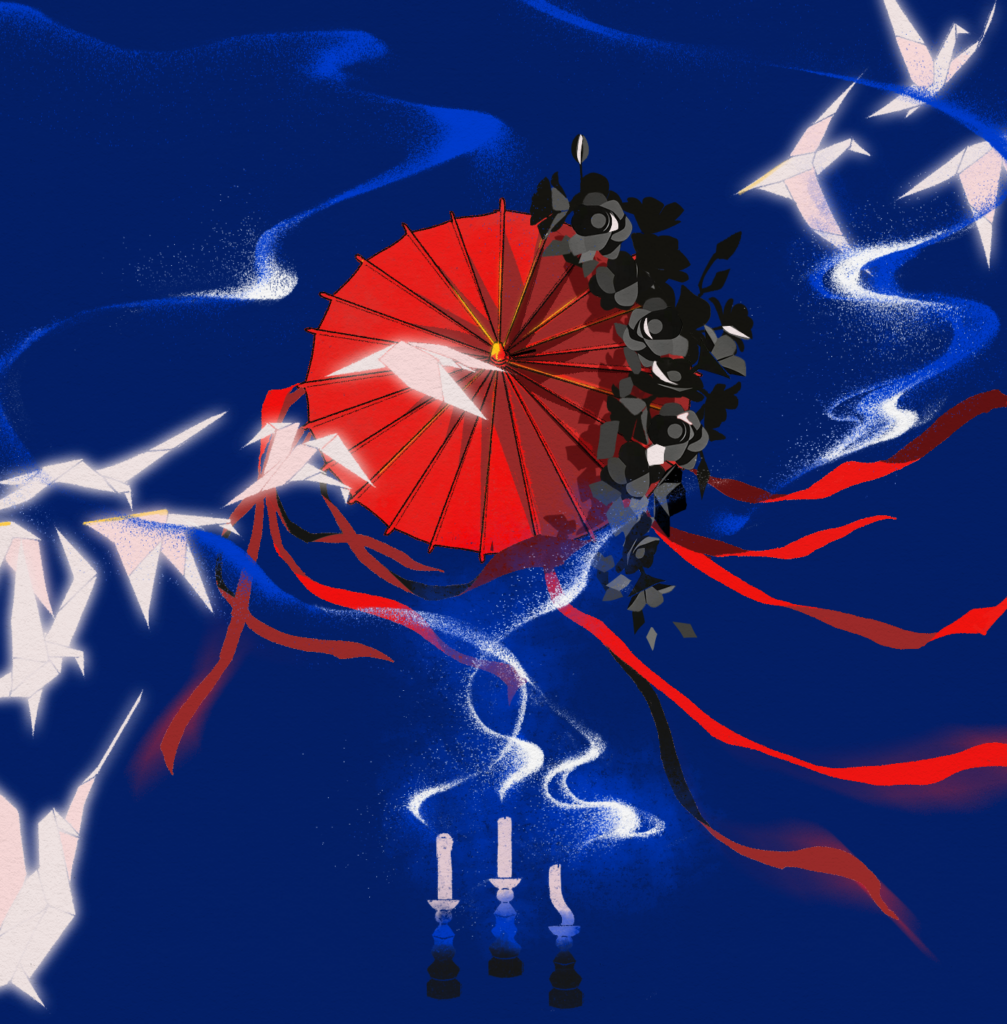
I had never heard similar tunes before, and Jinchao’s delivery differed a lot from that of the bud in Fusui County. She revealed that the tunes she’d played came from Vietnam. Jinchao is fluent in more than four languages. She was born in Vietnam, then adopted by relatives in China. She went to school in Vietnam as a teenager, but then returned to China to take care of her adoptive parents, got married, had children and stayed. Officially, she is Vietnamese, but the ethnic groups within the culture of the bud and moed are transnational. In China, they are recognised as different branches of Zhuang ethnicity (Bouxcuengh or Bouxdoj in Latin Zhuang); in Vietnam, they are part of the Tày and Nùng (Dai 岱 and Nong 儂 in Chinese) ethnic groups.
The Tay are the minority nationality in Vietnam with the largest population and possess a high political and cultural status. In the 16th century, Cao Bang, which the Tay inhabited, became the political and economic centre of Vietnam. After the establishment of the Socialist Republic of Vietnam, a group of Tay people who took a hand in the revolution at an early stage held important positions in the government, such as Nong Duc Manh, an ethnic Tay, once the General Secretary of the Communist Party of Vietnam. Thanks to their efforts, Tay culture has received significant attention in Vietnam.
Hai Hua, a scholar of Sino-Vietnamese ethnic cultures, views these events as the driving force behind the rise of Tay culture, in which bud and moed are significant elements. The École française d’Extrême-Orient (EFEO)’s research in Vietnam bolstered international academia’s familiarity with bud and moed. The ritual of the tinh lute in particular is more abundant in Vietnam. In Longzhou, Dongxiang and other places near the Sino-Vietnamese border, people claim that Vietnam uses the tinh lute to compete against China. Since 2004, Vietnam has been vigorously promoting tinh lute culture, advocating for the performance of tinh lute on stage and establishing a series of professional schools. Tinh lute playing is quickly expanding from the north throughout the whole country.
When Vietnam moved to register the tinh lute ritual with UNESCO, Chinese scholars feared it could reshape the cultural identity of border ethnic groups – and with it, threaten China’s territorial integrity. Even though it was unclear which country had a longer history of the tinh lute ritual (given that it spanned the two nations), Vietnam still had the power to make a unilateral application. Lao Zhao, then chairman of the Institute of Ethnic Studies at the Guangxi Academy of Social Sciences, thought that Vietnam’s decision not to join China in a joint ICH application might suggest ulterior motives. He drafted a report on a joint application for tinh lute ICH registration with other organisations in Guangxi. The report eventually reached Beijing, and was approved by the top brass. In October 2018, the Ministry of Culture sent a team to the Sino–Vietnamese border to investigate the tinh lute ritual.
ICH registration China's ICH process requires approval at every level – county, city, provincial, national – before international nomination.


Some investigators were supportive of the ritual and bud and moed culture; others turned up their noses and took it as nothing more than superstition. Meanwhile, in 2019, UNESCO registered the practices of the tinh lute ritual by Tày, Nùng and Thái Ethnic Groups in Vietnam on the ICH list. In 2020, the Cultural Department of Guangxi finally got a formal reply from a higher authority. They received a suggestion from above to reclassify the tinh lute application in the category of art and music, and to not mention religion and folk beliefs in connection with it again.
They did just that.
Formal reply 回复 ‘huí fù’ denotes a formal written reply from a higher authority within China's bureaucratic system – not merely a response, but an official directive carrying administrative guidance and weight for government departments below.

Applying for ICH designation requires situating a practice within a specific lineage – ideally this would mean formally bud or moed practitioners as its legitimate inheritors. I asked a Cultural Department official involved in the application how they navigated this core tension: “We just wrote that the tinh lute has gone through an evolutionary process from entertaining the heavens to entertaining people,” they replied.
In May 2021, the ‘Zhuang tinh lute art’ of Chongzuo (a city in Guangxi near the border) was added to the ICH list, with a report about the list saying that “Through the excavation and improvement by musicians, the tinh lute has gradually stripped away its ancient primitive religious sentiment and turned into a charismatic national musical instrument”.
In the summer of 2020, Ah Lei was invited to perform the ceremony of Grain Restocking (補糧 in Chinese; Boujliengz or aeuliengz in latin Zhuang) in Pingxiang for a family of Vietnamese-Chinese. The Zhuang people believe that each human lives out of a barn of their own. When they reach a certain age, the rice in the barn will be used up, and then they’ll need a budgong to restock their barn and extend their longevity.
The putative barn running out of rice does not have to be there for the ceremony (in this case she was in Canada with one of her daughters); only their children and the budgong are required to be present. Ah Lei was not accompanied by his usual assistant, and was instead helped by Xiao Lu, a fan of bud and moed ceremonies in Pingxiang. Xiao Lu, although an enthusiast, was not good at assisting the budgong.
Ah Lei instructed the host family one by one to prepare glutinous rice and bamboo poles and to disentangle the paper clothes that would be burned as offerings. As for the other paper cuttings for the ceremony (such as that of Mao Lang – a ritual object in human form – climbing the ladder to heaven), he had to do them himself.
Burned as offerings 燒衣 ‘shāo yī’ – literally "burning clothes" – is a ritual offering in which paper garments and goods are burned to transmit material comfort to ancestors and spirits in the afterlife, a practice common across Chinese and Zhuang folk traditions.
“Do you know how to cut it?” Ah Lei looked up at the second sister of the host family.
She shook her head in a panic: “I’ve never cut it before.”
“And you don’t know how to do it?” Sister Hai, the eldest daughter of the host family, asked Xiao Lu.
Xiao Lu said, “My dad knows how to cut it in my family.”
For some time, everyone was just looking at each other. But the hardest part was yet to come. Ah Lei needed someone to shake the horses during the ceremony. Sister Hai went through the neighbours who might know how to and concluded that they were all either too old or away from home. Xiao Lu even began to think about me: “Does she know? The girl you brought here?”
Ah Lei looked at him and said matter-of-factly, “Anyone can do it. you can do it too.”
The ceremony was held on the sixth floor in the family’s shrine room. It was very hot, and the room had no ventilation. With tear-blurred eyes from the smoke, I saw Sister Hai turning on a video call. A grey-haired woman appeared on the phone screen.
“Ah Ma, look, the laoshi has come to resupply the rice in your barn,” she said. It was daytime on the screen, and the old woman, dressed in purple silk, squinted into the screen. Sister Hai propped the phone next to Ah Lei, who was playing the tinh lute. The room on the screen, with its LCD TV and chandeliers, was framed as a small white tile in the real world of candles, tinh lute, flowers, and golden brass rings. Sister Hai told her grandmother cheerfully, “Live a long and healthy 800-year life.”
The ceremony went on all night. A few seniors came to sit in the narrow doorway; when they heard that there was a laoshi performing in this house, they’d climbed, panting, up six floors to watch. In the end, the daughters of the host family added rice and coins to the rice jar, a symbol of their mother’s barn, and sealed it under the instruction of Ah Lei.
It was unlikely that Sister Hai understood what Ah Lei was singing. The local Zhuang language of Pingxiang differs greatly from that of Fusui; furthermore the budgong there always sings in ancient Zhuang. However, I saw an unusual kind of emotional solemnity on her face as she listened to him, his hands plucking the strings of the tinh lute with Xiao Lu shaking the brass rings. On the way back from Pingxiang, Ah Lei asked me if I could understand Sister Hai’s Vietnamese. I said “no” and asked if he could. He said he could understand only a little, but there were exceptions.
“Like when?” I asked him.
“When I was inviting a god, but a Vietnamese ghost came, then I could suddenly speak Vietnamese,” he replied, straight-faced.
I haven’t encountered any Vietnamese gods or ghosts in Ah Lei’s ceremonies, but I have seen a few unserious ones. ‘Crossing the Street’ is the name for the part of the tinh lute ceremony when the bud or moed asks the god to descend – but who knows which god will descend? Once as he was ‘Crossing the Street’, Ah Lei looked around with an irritated face. The grannies around him took the hint and started to light tobacco and toast to him. After he smoked a pouch of tobacco, Ah Lei started to ‘speak for the gods’ in a tone remarkably nonchalant and unruffled. Before he’d finished singing, the grannies all collapsed with laughter. The one nearest to him blushed. She covered her face and said, “I mean, do you really want someone this old?”
I asked Tan Sangu, one of Ah Lei’s most loyal followers, to translate what Ah Lei sang. She puffed with laughter and told me that the god who just descended had fallen in love with the granny next to Ah Lei and had said, “Last time we pledged love under the moon and before the flowers. This time, I only hope to be in a pair with you together.”
Every time Ah Lei performs a ceremony, his house is packed with “seven aunts and six grannies” from nearby. Ah Lei calls them, half-jokingly, his ‘fans’. They’re his most honest audience: in the not-so-fun parts of ceremonies, they have no scruples about falling asleep in front of him. Some only come to be included in the fun of huddling together, constantly chittering and chattering. When I asked one old woman if she could understand what the master was singing, she shook her head and said: “Not really.”
Seven aunts and six grannies 七大姑六大婆 ‘qī dà gū liù dà pó’ – literally "seven aunts and six grandmothers" – is a Chinese idiom for gossiping busybodies, used here tongue-in-cheek by Ah Lei with his characteristic wit.
My grandmother used to say that on this day, the souls of the underworld return home – and the burning paper money lights their road and pays their passage back.
Tan Sangu is a relatively experienced member of the audience. She has been following Ah Lei for many years and comes to almost every big ceremony. She can make all kinds of ritual items – paper cranes, paper flowers, Mao Lang – and can turn the wastepaper and paper shells from old cigarette boxes into exquisite paper-collage clothes. She was exceptionally bright as a teenager. However, because her father came from a so-called “bad personal background”, a group attacked during the Cultural Revolution, she was not given the chance to go to university. When her children grew up and started their working lives, she was no longer content to stay at home with her “know-nothing” husband. She is happiest when she is out singing with her “sisters” and riding her scooter to watch ceremonies at Ah Lei’s house.
Most people who come to watch the ceremonies are women, but at large-scale ceremonies, uncles will come to help set up the venue or slaughter chickens and pigs. At the Festival of Fasting in Fusui, bud and moed perform the Heavenly Wine ritual for three days to pray for the wellbeing of the entire clan, and all villagers must participate. In Jinlongdong, on the Sino-Vietnamese border, people celebrate the Nongdong 弄下 峝 festival before the official start of tilling at the beginning of spring. Bud and moed perform the ritual 求務 (Cầu Mùa in Vietnamese), which means Praying for Good Harvest, for the whole village, praying for favourable winds and rain and asking the Jade Emperor for seeds and bumper crops in exchange.
Bud and moed still carry the mission of performing these rituals, even if they are not considered necessary in modern society. In 2018, a scholar named Xiong Xun came to Jinlongdong to film a documentary on the festival. A village clerk told Xiong Xun: “This year, we’re too busy with poverty-relief work to allocate money for the Nongdong festival.” But the budgong still came to the fields in the early morning to offer sacrifices to the gods and pray for the village, even though there were only about twenty villagers present. He said that it was not an assignment for him, but an obligation.
Zhuang people burn paper money for the dead by the road on the fourteenth day of the seventh month every year. One year, Ah Lei and I went to a crossroads near his village known as the ‘Horror Corner’ (it’s the scene of many car accidents). But when the fire lit up, I wasn’t thinking of horror stories. My grandmother used to say that on this day, the souls of the underworld return home – and the burning paper money lights their road and pays their passage back.
Before Ah Lei became a bud, not many people had gone to the crossroads to offer sacrifices. “But you can’t blame the villagers for abandoning their traditions so easily,” he told me. “There are many people wandering in the outside world, but few at home to offer sacrifices to the dead.”
Traditionally, bud and moed would make a living by farming alongside performing rituals. But farming life is no longer a viable option, and the local government’s main method to raise poor villagers out of poverty is to mobilise them to go to cities to work. So, some bud and moed have begun to charge fees for ceremonies performed for private events. But they need to take extra care to separate their activities from the “superstitious” ones, like those offered by fortune-tellers at festivals and attractions. whom Ah Lei’s mother and auntie call “swindlers”.
Ah Lei’s father told me that once his co-worker from Anhui Province asked Ah Lei to read his fortune. Ah Lei hesitated for a long time, unsure if his troops and horses could go that far, or if he could get help from the local gods. Eventually, Ah Lei agreed and his fortune-telling “turned out to be true”, said Ah Lei’s father. Respecting the power of the gods, and recognising that they merely borrow this power to help people, is the basis by which bud and moed distinguish themselves from feudal-era superstitions and the swindlers. But the inclusion of the tinh lute on the ICH list has also legitimised their identity: they are no longer just shamans, but inheritors of ‘Intangible Cultural Heritage’. But what exactly is superstition? Bud and moed culture, as a category of folk belief, is not that easy to separate from feudal-era superstition.
Feudal era superstition Dismissed as a feudal superstition since the Republic of China era, shamanic practice has faced fluctuating state control – tightening under the Cultural Revolution and again recently, reflecting stricter enforcement rather than new hostility.
The People’s Congress of Chongzuo held several meetings to discuss how to preserve tinh lute culture after its ICH listing. One of the most debated issues was the boundary between traditional culture and feudal superstition. Some scholars defined the line based on whether there was a charge for the ceremony; a more popular but less unsophisticated way to differentiate between the two was whether incense was lit.
Many young people like to post videos of their performance of rituals on video platforms like Douyin, the Chinese version of TikTok, and Kuaishou. The labels attached to these videos are mostly “ICH”, “tinh lute”, and “national culture”, just like how they named their groups – “Tinh lute Culture Exchange Group”. After some accounts were closed or restricted they figured out the secret of how to “pass the test” – videos with incense and candles are easily recognized as violations of the unpublished rule.
In April, 2021, Guangxi Department of Culture and Tourism held a Zhuang tinh lute festival in celebration of the “The Third Day of the Third Month”. In the traditional repertoire section, five bud and moed, including Ah Lei, were invited to perform ritual pieces. It was the first time I had seen bud and moed on stage for a specific ritual occasion. They all seemed a bit nervous, singing out of tune and playing the wrong notes. Ah Lei’s hair was sticking to his forehead from sweat.
Incense must not be lit on stage in public, and there were no ritual items on stage, but Ah Rong, an apprentice bud, was called in at the last moment to shake the horses. As a boy, he had taught himself to play the tinh lute, became active in various tinh lute and folk song events and familiar with the young masters. When I met him, I asked him if he would sing traditional ritual songs on stage.
Ah Rong shook his head: “If you don’t light up incense, what if something goes awry? Isn’t it good enough for me to just sing folk songs?”
But what exactly is superstition? Bud and moed culture, as a category of folk belief, is not that easy to separate from feudal-era superstition.
A former administrator of religious affairs in the local government said he understood the mentality. He said: “Look at those who perform climbing on the mountain of swords and plunging into a sea of flames on the stage. They are all secretly lighting up incense backstage. If we don’t allow them to light incense, who will be responsible if something goes wrong, while there is no incense to bless them? But it can only be used for a folk ritual. It can’t be brought to the public as legitimate art,” he said.
A scholar from Beijing once asked Ah Rong and a budgong to perform a ritual song. Ah Rong was worried that the troops and horses would be drawn in and make him dizzy without the incense lit. However, to light the incense in front of a scholar would make their performances look superstitious. Their solution was to sing a short excerpt that mixed the lyrics of different sections of ritual songs topsy-turvy, so as not to disturb the troops and horses.
Few ritual songs can be sung on stage and there are few new arrangements, and so the repertoire for tinh lute performers in China is limited. Ah Lei doesn’t like the new songs much.
“Other people [meaning Vietnamese] also perform on stage, but their style is more gentle”, he explained, while we drank milk tea. “For us, you know, the ancient religious blessings of tinh lute still works to help grow crops”. Holding his grass jelly milk tea with both hands, he drew an analogy: a tinh lute performance without traditional tunes would taste as dull as roasted grass jelly without milk tea.
He pulled out his phone to show me a video of a tinh lute performance in Vietnam (many Chinese bud and moed watch Vietnamese ceremonies online, which have more varied performance styles and a richer repertoire).
The governments on the two sides of the border nervously compete for ownership of the ICH. But ordinary people in both countries don’t always distinguish between ‘us’ and ‘them’. At least before Covid, the Chinese and Vietnamese people living near the border had always joined in each other’s festivals, sung songs to each other and intermarried. The Nongdong festival is held on a rotating basis: from the eighth to the fourteenth day of the first month it occurs in different villages on the Chinese side of the border, and then transitions to Halang on the Vietnamese side from the fifteenth day of the month.
Many Chinese bud and moed and tinh lute fans learn the Vietnamese way of playing by watching videos or through exchanges. Some researchers are anxious that ‘our’ culture is being carried away by Vietnam, but the scholar Hai Hua isn’t concerned: “Why does it matter? Vietnamese would also say they learn from you, the Zhuang people. We should have that cultural confidence.” He believes that it is not one way: masters in Vietnam also learn from the performances, dresses and songs of the Chinese.
Hai Hua is more worried that many young masters have gone off course in another way. He is concerned that ritual is becoming a tool to make money under the name of tradition, and that eventually the rites will evolve into superstitious activities to scrounge from local people. There are, indeed, some people who use rituals as a way to make money. One of Ah Lei’s young apprentices is also an investor, greases his hair and drives a BMW. I asked him why he wanted to be a bud. He told me: “You can’t do investment your whole life. You want to learn a skill to have a make a living when you get old.”
Hai Hua believes that the traditional bud is not like this. No old bud and moed ever made a fortune even after years of performing rituals. Ah Lei’s fellow junior apprentice, Master Nong, is in her seventies and has been a moed for a decade. Tan Sangu told me that she was living “like a caveman”.
The feeling of poverty and the misery it brought into their life are still vivid to Ah Lei’s family. They shared with me that Ah Lei and his sister started working in the field when they were five years old. At one Mid-Autumn Festival, Auntie Qiu found the children eating congee at home, with no mooncakes or meat, when she just got back from the city where she worked as cheap labour. It was well known that there was more money to be made working in factories. However, relatives would return from this work ill – the family’s money would be spent on hospital bills treating the illness caused by the harsh conditions of assembly line work.
His sister says that Ah Lei was always a hard worker with high hopes. Being a budgong is the longest “job” Ah Lei has ever taken, and the one he has worked the hardest at. Unlike the old bud and moed whose main occupation was farming, he is out on the road for rituals almost every day, from village to village, city to city, and singing overnight for seven or eight hours every few days, sometimes with dark circles under his eyes.
Although Ah Lei occasionally complains about how tired he is, he enjoys this full-time job. He has gotten used to being with his troops and horses all the time. Sometimes I sensed that Ah Lei felt indebted to the troops and horses for picking him. When he talked about his personal story of religious ecstasy, he said: “It was probably because my family was so poor at that time, and the gods would know that it’s better this way: it’s better to guide this kind of person to goodness.” He believes the gods are more willing to pick the poor, just as the poor believe in the gods more than the rich.
The very poorest people cannot be bud and moed, however. After Jin Chao, another budgong, finished his apprenticeship, it took him a long time to start his own practice because he needed to buy sacrificial offerings and ritual supplies for the ceremonies he performed, and also needed to maintain the offerings for the shrine in his own household. Most of the ritual items offered by his followers are packaged and distributed back to them after being presented as sacrifices. If bud and moed keep too many of the offerings, they are criticised.
Ah Lei works very hard to support himself with what he earns from performing the rituals – he is on the road for rituals almost every day, singing overnight for seven or eight hours every few days. “Why do you always perform at night?” I asked as I was about to fall apart after staying up two nights. He rolled his eyes: “That’s just the way passed down from our ancestors.”
He told me that tradition considers day and night are reversed in the human and spirit worlds, so the rituals are carried out at the turn of the day and night. However, he sometimes does some fine-tuning, such as starting a bit earlier at the Mid-Autumn Festival, so he can finish earlier to eat barbecue and sing karaoke with his friends.
Ah Lei is cautious about translating traditions into modern knowledge, but he clearly wants to be understood by people outside his small circle. He is a virtuoso at discussing traditions in modern terms, and always emphasises “positive energy” (正能量 zhèng néngliàng) when posting on Douyin. He discusses the varieties and tunes of the tinh lute in a WeChat group. As a modern budgong, he advises those who ask for healing rituals to go to the hospital first and persuades them to believe in science. When a reporter from a regional TV station asked him about why he decided to learn the tinh lute, he set aside all talk about religious ecstasy and being chosen by the ghosts and gods, instead providing an attack-proof answer: “Because this is our culture, and I feel the responsibility to pass it on.”
The COVID pandemic went on longer than anyone anticipated, and the prayers of bud and moed didn’t seem to help much. In August 2022, the border was once again closed. Ah Lei asked me one day, half-whining: “Do we have to be quarantined in Nanning now?” He is frustrated by the fact that every time there is a shutdown, he can’t move across the regions as freely as he wants and usually does, and his job is affected because of it.
At the time of writing in late 2022, the border remained closed from time to time. While quarantined at home, I watched the footage I took the first time I went to Ah Lei’s house. He sat cross-legged in the middle of the hall, singing about the paper cranes flying up to the sky and sugar canes being brewed into wine. I imagined that the old people in that small room who had never left the village were roaming different worlds with him.
Back when I shot this video, when I couldn’t understand the lyrics, it was just pungent smoke from joss sticks and candles that suffocated me and filled my eyes with tears. I recalled Hai Hua’s lament that many scholars who study tinh lute cannot understand the words sung by bud and moed and do not know how to shake horses.
I thought of the morning after the ceremony of Grain Restocking, when Ah Lei and Sister Hai were resting up and eating fruits on a cooling mat on the balcony. They were talking about bud and moed in the neighbouring villages, about which old man had passed away and which young man had inherited the family business, about which villages no longer had bud and moed. Out of the misty shade of the distant mountains seeped the crows of roosters. On the balcony chickens and ducks poked their heads out through the gaps between the bars of their cages.
I wondered what they could see in the darkness. The faint silhouettes of the dragon fruit vines creeping upstairs had already begun to emerge through the fading darkness.
Perhaps they knew that if you kept gazing to the east, eventually you would see the sky lighten up.
Note: All names are pseudonyms
This article is prize-winning work from the Frontline Fellowship, published as part of a collaborative series between Translator and the Frontline Non-Fiction Translation Fellowship. The fellowship was jointly funded in 2024 by the Cheng Shewo Memorial Fund, Duke Story Lab, and Frontline Fellowship. Founded in 2021, the fellowship supports Chinese-language writers and translators worldwide with funding and editorial support to tell urgent, deeply personal non-fiction stories.