Translator reviews an established Japanese translator’s debut novel and Boris Dralyuks’s translation of Alexander Voloshin’s mock epic poem.
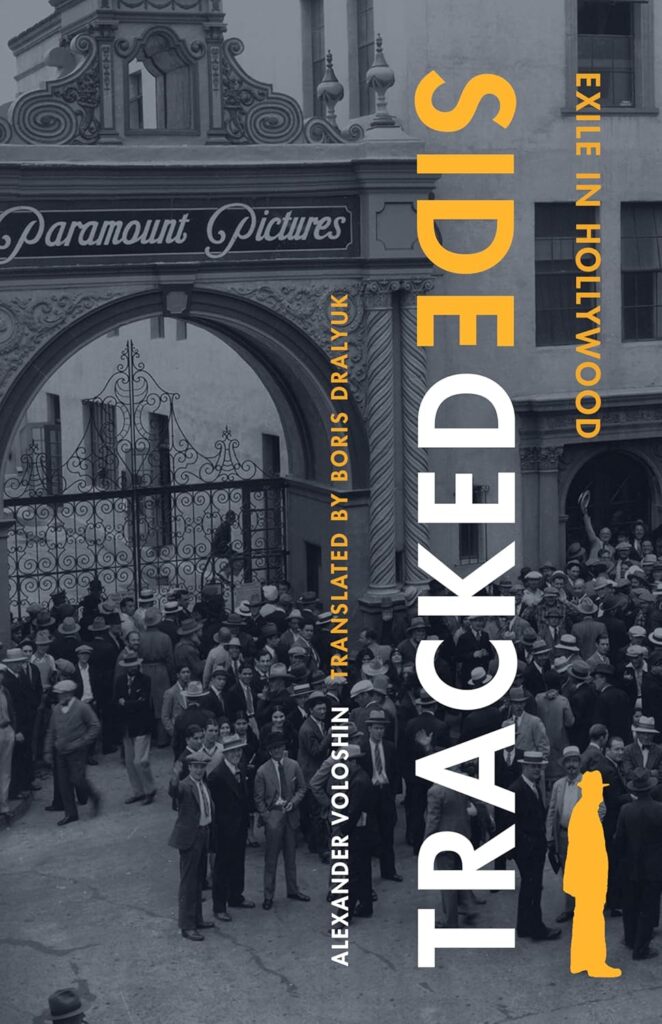
After the October Revolution of 1917 and the civil war which followed, thousands fled the former Russian Empire. Berlin, Shanghai, and Paris became hotspots of émigré culture. A few ended up in sunny Southern California, drawn to dreams of Hollywood and palm trees. Their unlikely fate as movie extras is captured in Alexander Voloshin’s mock epic poem Sidetracked: Exile in Hollywood (1953). His parody of 19th-century verse comes alive in Boris Dralyuk’s inventive and often hilarious translation. Voloshin depicts Hollywood between the wars as a place of hustle, rather than glamour, with a Ukrainian exile caught in its midst, scrambling for survival and screen credits.
Born in Ukraine, Voloshin was a theatre actor who performed with both Ukrainian and Russian troupes before World War I. Sidetracked traces his extraordinary migration route in its wake – out from Crimea, and then through Istanbul, Berlin, São Paulo, and New York before finally reaching Los Angeles. Under the name Alex Woloshin, he appeared in dozens of Hollywood films in the late 1920s and 1930s as an uncredited background actor, before ending his days as a taxi driver. Some of the films have been lost. Amongst those that remain are Voloshin’s roles as ‘Hotel Clerk’ in His Private Life (1928), ‘Russian General in Jail’ in You Can’t Take It With You (1938), and as Stalin himself in Josef von Sternberg’s The Last Command (1928).
Voloshin’s poem directly alludes to The Last Command, which features a penniless Russian duke waiting for calls from his casting agent. Satirising Sternberg’s film, the poem depicts a day in the life of a Russian extra being ghosted by his agent. Bored and depressed, he opens up the newspapers to read about a looming war. “Our own era’s doomscrollers,” Dralyuk cheekily sums it up in his introduction, “know just how the extra feels.” At the end of the day, the poor extra is still waiting for the call that never comes.
In The World and the Flesh (1932), Voloshin plays an unshaven workman in a leather jacket who storms an upper-class dining room. Dralyuk shines not just as translator of Voloshin’s poetry but also as a brilliant critic of his film work: “Voloshin says nothing. Instead, he lowers and raises his stubbly face, feasting his eyes both on [Miriam] Hopkins and on the delicacies laid out before her. His grin shifts almost imperceptibly, registering awe, resentment, lust, and hunger. Après lui, le déluge.”
Voloshin’s standout performance riffs on a familiar cliché: Russian imperial officers and aristocrats, now film extras, are cast to play “jolly serfs who work the land”. Sidetracked ironises their downfall: “Lawyers driving cabs all day, / doctors getting paid to sing, / high-born ladies waitressing.” The trope of the impoverished Russian émigré turned movie extra even appears in Vladimir Nabokov’s first novel, Mary, in 1926: “these flickering, shadowy doppelgängers, the casual Russian film extras, sold for ten marks apiece and still flitting, God knows where, across the white gleam of a screen.” Nabokov himself worked a few shifts as an extra in 1925, leaving the set with $10 in his hand.
Dralyuk masterfully renders Voloshin’s verse into lively English. His translation gestures to the period in which the poem was written, while sounding remarkably fresh in 2026. Voloshin’s original poem is composed in Hudibrastic couplets, a form of satirical verse that mocks heroic poetry. Because this form has strong traditions in both Russian and English, it allows Dralyuk to recreate the comic rhythm. The poem itself plays with multiple languages and translation. In the Russian original, Voloshin peppers his verse with Ukrainian words, a reflection of his bilingual background. He also incorporates common English expressions like “pocket money” and “gum”, adding charming everydayness. Dralyuk’s translation captures this interplay of languages, preserving the poem’s multilingual texture for English readers.
Read in the shadow of Russia’s war on Ukraine, linguistic nuances take on new weight. Interestingly, in one of the few films where he had lines, Robert Florey’s Daughter of Shanghai (1937), Voloshin spoke Ukrainian. The fate his homeland suffered under Bolshevik terror and war is not just a subtext of Sidetracked but a main theme: “Brothers will once again embrace – / with joyful effort, we’ll replace, / rebuild all that has been destroyed, / revive the land, refill the void…”
Like many exiles, Voloshin’s poem is nostalgic about the country he left behind. Pre-revolutionary Ukraine is depicted as a land of plenty: “Blue and yellow flags would wave… / We all danced and drank, had fun, / tried to speak our mova-tongue.” Here, the translation is ingenious: mova (Ukrainian for ‘language’) not only sounds like ‘mother’ when read aloud but also signals Voloshin’s pride in his heritage. Another coup is rhyming “goodbye” with “prash-chai”, which is a phonetic rendering of the Russian word for ‘goodbye’. What follows is a lively tableau of Ukrainian folk culture, featuring the bandura (a lute-like instrument), uzvar (a sweet fruit punch) and kutia (a grain dish), kobzars (blind bards), the hopak (a battle dance) and horilka (Ukrainian vodka).
The feast depicted in Voloshin’s poem is accompanied by the “warm, round loaves of palianytsia” (hearth-baked bread). During today’s war in Ukraine, palianytsia – difficult to pronounce for Russian speakers – became a shibboleth to identify enemies and saboteurs. One couplet from Voloshin’s text reads with eerily contemporary resonance: “What did they, in Europe, care / about bloodshed over there, / in Crimea, Perekop –” (now occupied by Russia).
Other stanzas strike a lighter note, describing how the exiles adapt to the American way of life. No longer foreigners, they now greet each other in English: “Hello! How do you do?” But one problem remains for them in 1920s America: prohibition – so they make their own spotykach (herbal liqueur). Not all dreams come true in Hollywood, it turns out. Flitting across the silver screen pays only “pocket money”, not big bucks. Voloshin warns: “Reader, it’s time you understood / there’s no free lunch in Hollywood!”